
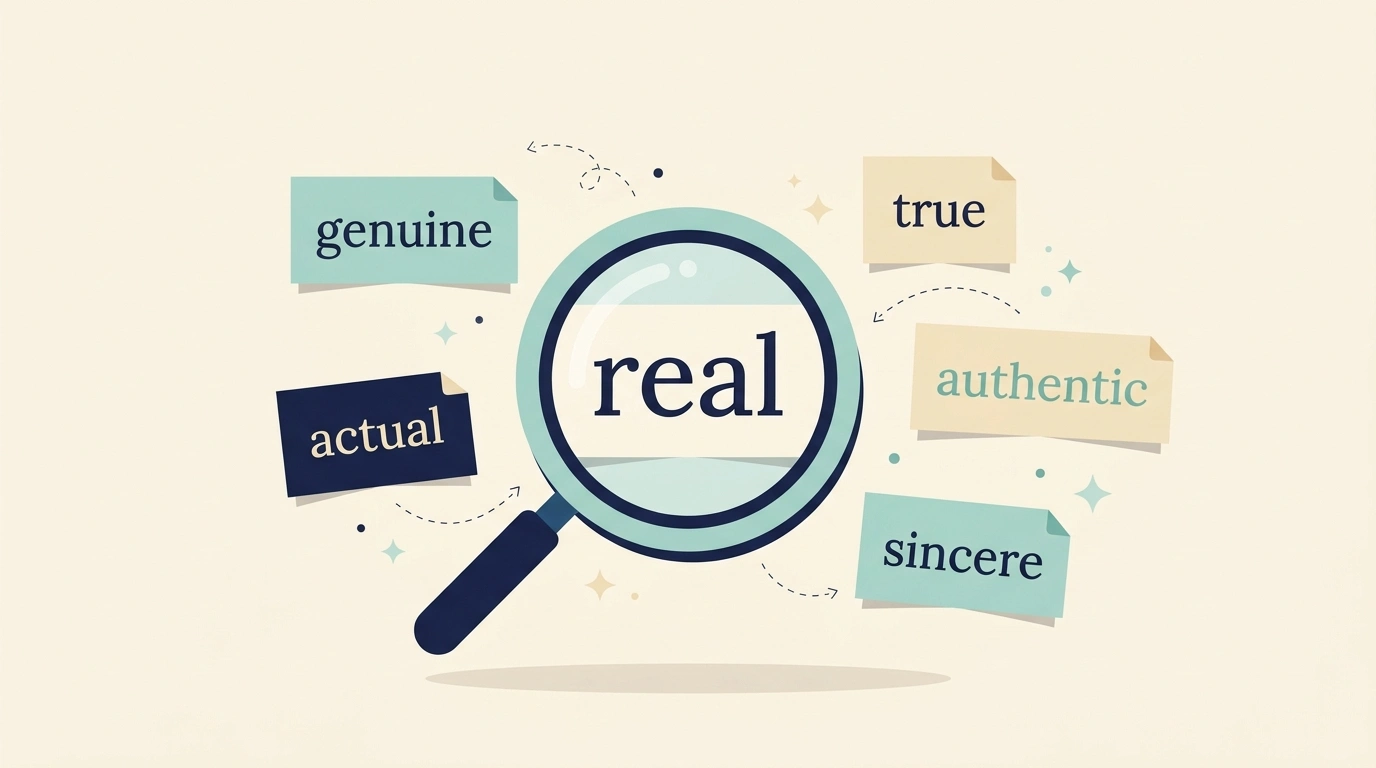
The closest everyday alternatives to “real” are genuine, actual, and true. Use “genuine” when something is not fake, “actual” when something exists in fact, and “true” when something matches the facts.
The best choice depends on meaning. “Real” can describe things that exist, things that are not fake, feelings that are sincere, or a strong degree, as in “a real mess.” It also has a legal meaning in terms like “real estate.”
Quick list: genuine, actual, true, authentic, legitimate, factual, tangible, sincere, honest, utter
This article looks at 30 alternatives. For each one it gives the meaning, IPA, a usage note, and an example, so you can match the word to the context.
At a Glance: Real Synonyms and Related Alternatives
| Alternative | Part of Speech | Meaning | Register / Tone | Ideal Context |
| Genuine | Adjective | Not fake; truly what it is said to be | Neutral | Products, feelings, people |
| Actual | Adjective | Existing in fact | Neutral | Facts, numbers, events |
| True | Adjective | In agreement with fact or reality | Neutral | Stories, statements, reasons |
| Authentic | Adjective | Proven to be what it claims to be | Neutral to formal | Art, food, documents, culture |
| Factual | Adjective | Based on facts | Neutral to formal | Reports, news, accounts |
| Legitimate | Adjective | Lawful, valid, or properly accepted | Formal | Businesses, claims, reasons |
| Tangible | Adjective | Able to be touched or clearly seen | Neutral to formal | Results, benefits, proof |
| Sincere | Adjective | Honestly felt, without pretending | Neutral | Feelings, thanks, apologies |
| Honest | Adjective | Truthful and open | Neutral | People, answers, opinions |
| Utter | Adjective | Complete; total | Formal to literary | Strong negative or neutral descriptions |
Which Word Should You Use?
| If you want to… | Use | Why |
| Say something is not a copy or fake | Genuine | It is the most natural everyday choice for products and objects. |
| Say something exists in fact | Actual | It separates what happened from what was planned or imagined. |
| Say a story or statement matches the facts | True | It works for claims, stories, and reasons. |
| Say an item is truly from its claimed source | Authentic | It suggests proof of origin or tradition. |
| Say a feeling is honestly felt | Sincere | It describes emotions without pretending. |
| Say something is lawful or properly accepted | Legitimate | It fits official, business, and legal contexts. |
| Say something can be touched or clearly measured | Tangible | It describes things you can see or feel in the real world. |
| Strengthen a negative description | Utter | It works like the informal “real” in “a real mess.” |
Exploring the Multiple Meanings of “Real”
1. Actually Existing
- Meaning: Existing in fact; not imaginary.
- Explanation: This is the most basic sense. It separates what exists from what is only imagined, planned, or pretend.
- Example: The monster in the story felt real to the children.
2. Genuine, Not Fake
- Meaning: Being what it is said to be; not artificial or copied.
- Explanation: This sense is common with materials, products, and valuables. It focuses on whether the thing is authentic, not whether it exists.
- Example: The ring is made of real gold.
3. True or Factual
- Meaning: Matching the facts; not only appearing to be so.
- Explanation: Here “real” points to the true cause or the true situation behind what people see on the surface.
- Example: The real reason she left was the long daily trip to work.
4. Sincere or Not Pretending
- Meaning: Honestly felt or shown; free from pretending.
- Explanation: This sense is often used for feelings and people. A real friend is someone who is honest and loyal, not just friendly on the surface.
- Example: He showed real concern for the new student.
5. Complete or Absolute (Informal)
- Meaning: Used for emphasis to mean “complete” or “total.”
- Explanation: Dictionary.com notes that this sense is informal and mostly used in speech. The word “real” also works as an informal adverb, as in “real good.”
- Example: The broken heater was a real nuisance.
6. Relating to Property (Legal)
- Meaning: Relating to land and buildings, as opposed to movable goods.
- Explanation: This sense appears in fixed terms such as “real estate” and “real property.” It does not mean “genuine” in these phrases.
- Example: She works in real estate and sells family homes.
Sources: Merriam-Webster; Collins Dictionary; Dictionary.com; Etymonline
Analyzing 30 Real Alternatives in Detail
Some alternatives below are close synonyms of “real,” while others fit only one meaning or context, and each Usage note says which.
Core Synonyms
1. Genuine
IPA: /ˈdʒɛnjuɪn/ (US and UK)
Definition: Truly what it is said to be; not fake or copied.
- Usage: This is one of the closest everyday matches for “real,” especially for objects, materials, and feelings. It is neutral in tone.
- Example: The shop sells genuine leather bags.
2. Actual
IPA: /ˈæktʃuəl/ (US and UK)
Definition: Existing in fact; not just possible or planned.
- Usage: It matches the “actually existing” sense of “real.” It does not work for the “not fake” sense, so “actual leather” sounds less natural than “genuine leather.”
- Example: The actual cost was higher than the estimate.
3. True
IPA: /truː/ (US and UK)
Definition: In agreement with fact or reality.
- Usage: It replaces “real” when the idea is about facts, as in a true story or a true reason. It is less natural for physical objects.
- Example: The film is based on a true story.
4. Authentic
IPA: /ɔːˈθɛntɪk/ (US and UK)
Definition: Proven or accepted as being what it claims to be.
- Usage: It is a close synonym for the “not fake” sense. It often suggests a trusted origin, such as an authentic painting or authentic local food.
- Example: Experts confirmed that the signature was authentic.
5. Factual
IPA: /ˈfæktʃuəl/ (US and UK)
Definition: Based on or containing facts.
- Usage: It is a related alternative for the “true” sense only. It describes reports, accounts, and statements, and it does not describe objects or feelings.
- Example: The article gave a factual account of the accident.
Not Fake or Imitation
6. Legitimate
IPA: /lɪˈdʒɪtɪmət/ (US and UK)
Definition: Lawful, valid, or properly accepted.
- Usage: It is a related alternative with a formal tone. It means “real” in the sense of being allowed or reasonable, not in the sense of being physical.
- Example: Check that the website is a legitimate business before you pay.
7. Bona fide
IPA: US /ˌboʊnə ˈfaɪd/ · UK /ˌbəʊnə ˈfaɪdi/
Definition: Genuine and made in good faith; without fraud.
- Usage: It is a formal, often legal alternative, used for offers, buyers, and qualifications. It sounds stiff in casual speech.
- Example: The shop made a bona fide offer for the old building.
8. Original
IPA: /əˈrɪdʒɪnəl/ (US and UK)
Definition: Being the first or earliest form, and not a copy.
- Usage: It is a related alternative. An original is real in the sense of not being a copy, but a genuine copy of something may not be original.
- Example: The museum keeps the original letter in a glass case.
9. Pure
IPA: US /pjʊr/ · UK /pjʊə/
Definition: Not mixed with anything else.
- Usage: It is a related alternative for materials and substances. “Pure gold” means gold with no other metal mixed in, which is stricter than “real gold.”
- Example: The shop sells pure olive oil.
10. Natural
IPA: /ˈnætʃrəl/ (US and UK)
Definition: Made by nature, not by people or artificial processes.
- Usage: It is a related alternative.
- Example: She prefers natural fibers like cotton and wool.
11. Veritable
IPA: /ˈvɛrɪtəbəl/ (US and UK)
Definition: Being truly what the word says, often used for emphasis.
- Usage: It is a formal or literary related alternative, often used before a noun in a figurative way. It does not mean “not fake.”
- Example: The old library was a veritable treasure house of books.
Existing and Physical
12. Tangible
IPA: /ˈtændʒəbəl/ (US and UK)
Definition: Able to be touched, or clear enough to be seen as real.
- Usage: It is a related alternative for things that can be touched or clearly shown, such as results, benefits, or proof.
- Example: The new road brought tangible benefits to the town.
13. Concrete
IPA: US /kɑːnˈkriːt/ · UK /ˈkɒŋkriːt/
Definition: Existing in a form that can be seen or touched; specific and definite.
- Usage: It is a related alternative. “Concrete evidence” means real, specific proof.
- Example: The police found concrete evidence at the scene.
14. Material
IPA: US /məˈtɪriəl/ · UK /məˈtɪəriəl/
Definition: Relating to physical things, not the mind or spirit.
- Usage: It is a related alternative for the physical world. It does not mean “genuine,” and it can also mean “important” in legal contexts.
- Example: The material world matters less to him than his art.
15. Physical
IPA: /ˈfɪzɪkəl/ (US and UK)
Definition: Relating to the body or to matter that can be sensed.
- Usage: It is a related alternative for the “existing” sense. It contrasts with mental or imaginary things, not with fake ones.
- Example: The scientist wanted physical proof, not just a theory.
16. Substantial
IPA: /səbˈstænʃəl/ (US and UK)
Definition: Large in amount, or solid and strongly made.
- Usage: It is a related alternative, and its most common meaning today is “large.” In the “real” sense, it describes things with solid size or weight.
- Example: She made a substantial donation to the school.
17. Existent
IPA: /ɪɡˈzɪstənt/ (US and UK)
Definition: Having being; existing.
- Usage: It is a formal and rarer word, closest to the “actually existing” sense. In everyday English, “existing” or “real” is more natural.
- Example: The existent records show the building was finished in 1902.
Sincere and Honest
18. Sincere
IPA: US /sɪnˈsɪr/ · UK /sɪnˈsɪə/
Definition: Honestly felt or meant; free from pretending.
- Usage: It is a direct match for the “sincere feelings” sense of “real.” It describes people, thanks, and apologies, not objects.
- Example: Please accept my sincere thanks for your help.
19. Honest
IPA: US /ˈɑːnɪst/ · UK /ˈɒnɪst/
Definition: Truthful and not trying to deceive.
- Usage: It is a related alternative for people and speech. It works when “real” means open and truthful, as in “a real answer.”
- Example: Give me an honest answer about the plan.
20. Heartfelt
IPA: US /ˈhɑːrtfɛlt/ · UK /ˈhɑːtfɛlt/
Definition: Deeply and sincerely felt.
- Usage: It is a warm related alternative for emotions, thanks, and wishes. It carries more feeling than “sincere.”
- Example: The team sent a heartfelt message to the coach.
21. Earnest
IPA: US /ˈɝːnɪst/ · UK /ˈɜːnɪst/
Definition: Serious and sincere in purpose.
- Usage: It is a related alternative with a serious tone. It describes effort and intention, so it is narrower than “real.”
- Example: He made an earnest effort to learn the language.
22. Candid
IPA: /ˈkændɪd/ (US and UK)
Definition: Open and honest, especially when the truth is not easy to hear.
- Usage: It is a related alternative for speech and opinions. It is useful when “real” means saying what you truly think.
- Example: She gave a candid review of the book.
Informal and Intensifying Alternatives
23. Proper
IPA: US /ˈprɑːpər/ · UK /ˈprɒpə/
Definition: Of the right or expected kind.
- Usage: It is an informal, mostly British alternative to “real” when “real” means “a true example of its kind,” as in “a proper meal.” It is a related alternative, not an exact synonym.
- Example: After the long hike, we wanted a proper dinner.
24. Utter
IPA: US /ˈʌtər/ · UK /ˈʌtə/
Definition: Complete; total.
- Usage: It matches the informal “complete” sense of “real” in phrases like “a real mess.” It is stronger and more formal, and it is usually used for negative things.
- Example: The first draft was an utter disaster.
25. Downright
IPA: /ˈdaʊnraɪt/ (US and UK)
Definition: Complete or extreme, often in a negative way.
- Usage: It is a related alternative that matches the intensifying sense. It works as an adjective (“downright lie”) or an adverb (“downright rude”).
- Example: His reply was downright rude.
26. Truly
IPA: /ˈtruːli/ (US and UK)
Definition: In a true, honest, or complete way.
- Usage: It matches the informal adverb use of “real,” as in “real good.” It is the more standard choice in careful writing.
- Example: The view from the top was truly beautiful.
27. Really
IPA: US /ˈriːəli/ · UK /ˈrɪəli/
Definition: In fact; or to a high degree.
- Usage: It is the standard adverb form of “real” and the correct replacement for informal “real” in sentences like “real tired.” It does not replace the adjective.
- Example: She is really good at drawing.
Formal and Factual Alternatives
28. Objective
IPA: /əbˈdʒɛktɪv/ (US and UK)
Definition: Based on facts, not on personal feelings or opinions.
- Usage: It is a related alternative for things that exist outside someone’s mind. “Objective reality” is a formal phrase from philosophy and science.
- Example: The test gave objective results that anyone could check.
29. Verifiable
IPA: /ˈvɛrɪfaɪəbəl/ (US and UK)
Definition: Able to be checked and proved true.
- Usage: It is a related alternative for facts, claims, and data. It says the information can be tested, not just that it is real.
- Example: The newspaper only prints verifiable facts.
30. Valid
IPA: /ˈvælɪd/ (US and UK)
Definition: Based on good reasons, or accepted by law or rules.
- Usage: It is a related alternative for arguments, tickets, and documents. It is a good choice when “real” means “acceptable” or “counts as correct.”
- Example: You need a valid ticket to enter the stadium.
Sources: Merriam-Webster; Collins Dictionary; Dictionary.com
Real vs. Genuine vs. Authentic vs. Actual
These four words are often used for each other, but each one answers a slightly different question.
| Word | Question it answers | Best for | Example |
| Real | Does it exist, or is it fake? | General use | It was a real diamond. |
| Genuine | Is it truly what it is said to be? | Objects, feelings, people | She gave a genuine smile. |
| Authentic | Can its origin or style be trusted? | Art, food, documents, culture | We ate authentic Thai food. |
| Actual | Is it the fact, and not the plan or guess? | Numbers, events, details | The actual score was 3–2. |
“Real” also appears in economics. “Real wages” are wages adjusted for rising prices, and they are compared with “nominal wages,” which are the plain numbers on a paycheck. This is a special meaning, and none of the four words above can replace “real” in this phrase.
Sources: Merriam-Webster; Collins Dictionary; Dictionary.com
Real and Opposite/Paired Word Pairs
| Word | Paired Word | Note |
| Real | Fake | The most common everyday opposite for the “not genuine” sense. |
| Real | Imaginary | Contrasts what exists with what is only in the mind. |
| Real | False | Opposes the “true” sense, as in a real or false claim. |
| Real | Artificial | Contrasts natural or genuine things with man-made imitations. |
| Real | Nominal | Used in economics, as in real and nominal wages. |
| Real | Virtual | Contrasts physical places or events with online or computer-made ones. |
| Real | Pretend | Often used with children and play, as in real food and pretend food. |
Choose the opposite according to the sense of “real” you are using. “Fake” works for objects, “imaginary” works for things that do not exist, and “insincere” works for feelings. The opposite of “real estate” is “personal property,” which means movable goods.
Sources: Merriam-Webster; Collins Dictionary
Common Word Partners of “Real”
| Pattern | Common Partners | Example |
| real + noun (existing) | real life, real world, real people | In real life, he is very shy. |
| real + noun (genuine) | real gold, real leather, real name | The author wrote under a different name, not her real name. |
| real + noun (fact) | real reason, real problem, real answer | The real problem is the lack of time. |
| real + noun (property) | real estate, real property | He works as a real estate agent. |
| real + noun (feeling) | real friend, real love, real concern | A real friend tells you the truth. |
| real + time | real time | The app shows traffic in real time. |
| verb + real | feel real, seem real, look real | The painting looks so real. |
| for real | for real | Are you leaving for real this time? |
Sources: Merriam-Webster; Collins Dictionary; Dictionary.com
Idiomatic Phrases Featuring “Real”
1. The real deal
- Meaning: A person or thing that is truly what it is said to be, often with a high level of quality.
- Example: After hearing her play, the coach knew she was the real deal.
2. For real
- Meaning: Truly or seriously; not a joke or a test.
- Example: I thought it was a drill, but the alarm was for real.
3. Get real
- Meaning: An informal way of telling someone to be sensible and stop expecting unlikely things.
- Example: If you think we can finish in one day, get real.
4. The real McCoy
- Meaning: The genuine thing, not an imitation.
- Example: That watch is the real McCoy, not a copy.
Sources: Merriam-Webster; Collins Dictionary; Cambridge Dictionary
Word Formation of “Real”
Etymology & Structure
“Real” comes from Old French reel, meaning “real, actual.” That word came from Late Latin realis, which comes from Latin res, meaning “thing” or “matter.” In Medieval Latin, realis was also used in law for things rather than persons, which links to the “real estate” meaning. The Spanish coin called a “real” is a different word, from a word meaning “royal.”
Date and History
Etymonline records “real” in the sense of “actually existing” in the early 14th century and the sense “relating to things,” especially property, in the mid-15th century. Dictionary.com gives a first record of 1400–50. Dictionary sources differ slightly on dates, so you may see both.
Word Class Variations
- Adjective: real (comparative: realer; superlative: realest)
- Adverb: really; also informal “real” (“real good”)
- Noun: reality, realness, realism, realist
- Verb: realize (also spelled realise in British English)
- Related adjectives: unreal, surreal, realistic
Sources: Etymonline; Dictionary.com; Merriam-Webster
Common Word Choice Mistakes
- “A tangible person”: use “a real person.” “Tangible” describes things like results and proof, not people.
- “Factual feelings”: use “real feelings” or “genuine feelings.” “Factual” belongs to statements and reports.
- “It’s really tired” (formal writing): use “really tired” or “very tired.” Informal “real” is mostly for speech.
- “Genuine estate”: use “real estate.” This is a fixed legal term and cannot be changed.
- “Actual leather jacket”: use “real leather” or “genuine leather.” “Actual” does not work for the “not fake” sense.
- “Reel life”: use “real life.” “Reel” is a homophone in some accents, but it means a spool or a film roll.
- “A veritable apology”: use “a sincere apology.” “Veritable” is used for emphasis, not for honest feelings.
Frequently Asked Questions
What is the closest synonym for real?
“Genuine” is usually the closest in everyday use, especially when something is not fake. “Actual” and “true” are close for other senses.
What is a more formal word for real?
“Authentic,” “legitimate,” and “bona fide” are more formal options. “Verifiable” and “objective” fit scientific or factual writing.
What is the difference between real and genuine?
“Real” is broader and also means “existing.” “Genuine” focuses on whether something is truly what it is said to be, so it is better for objects and feelings.
What is the difference between real and actual?
“Actual” points to what exists in fact, as opposed to a plan or guess. “Real” can also mean “not fake,” which “actual” cannot.
What is the opposite of real?
It depends on the meaning. “Fake” is the usual opposite for objects, “imaginary” for things that do not exist, and “false” for statements.
Can real be used for people?
Yes. “A real friend” means a sincere and loyal friend. “Sincere,” “honest,” and “genuine” are close alternatives.
Can I say “real good”?
This is common in informal speech, especially in American English. In careful writing, use “really good” or “very good.”
What does “real” mean in “real estate”?
It refers to land and buildings, not to something genuine. Here “real” comes from the legal sense of things rather than persons.
Is real the same as true?
Not always. “True” mostly describes statements, stories, and facts, while “real” also describes physical things and feelings.
What is a good alternative to real for emphasis?
“Utter,” “downright,” and “complete” are strong options, as in “an utter mess.” The adverb “really” works with adjectives.
Conclusion
The closest alternatives to “real” are “genuine,” “actual,” and “true.” “Authentic,” “legitimate,” “sincere,” and “tangible” cover more specific meanings.
The right word depends on context because “real” has several senses. It can mean existing, not fake, true, sincere, or complete, and each alternative fits only some of these senses.
To choose well, first decide which sense you mean. Use “genuine” or “authentic” for fake versus real, “actual” or “true” for facts, “sincere” for feelings, and “utter” or “downright” for emphasis.

I’m Rida, an SEO enthusiast with a strong interest in digital marketing and online growth.
I have 3 years of experience in web designing and office management.
I enjoy creating user-friendly websites and exploring effective SEO strategies.
My goal is to help websites grow through smart, creative, and result-driven digital solutions.