
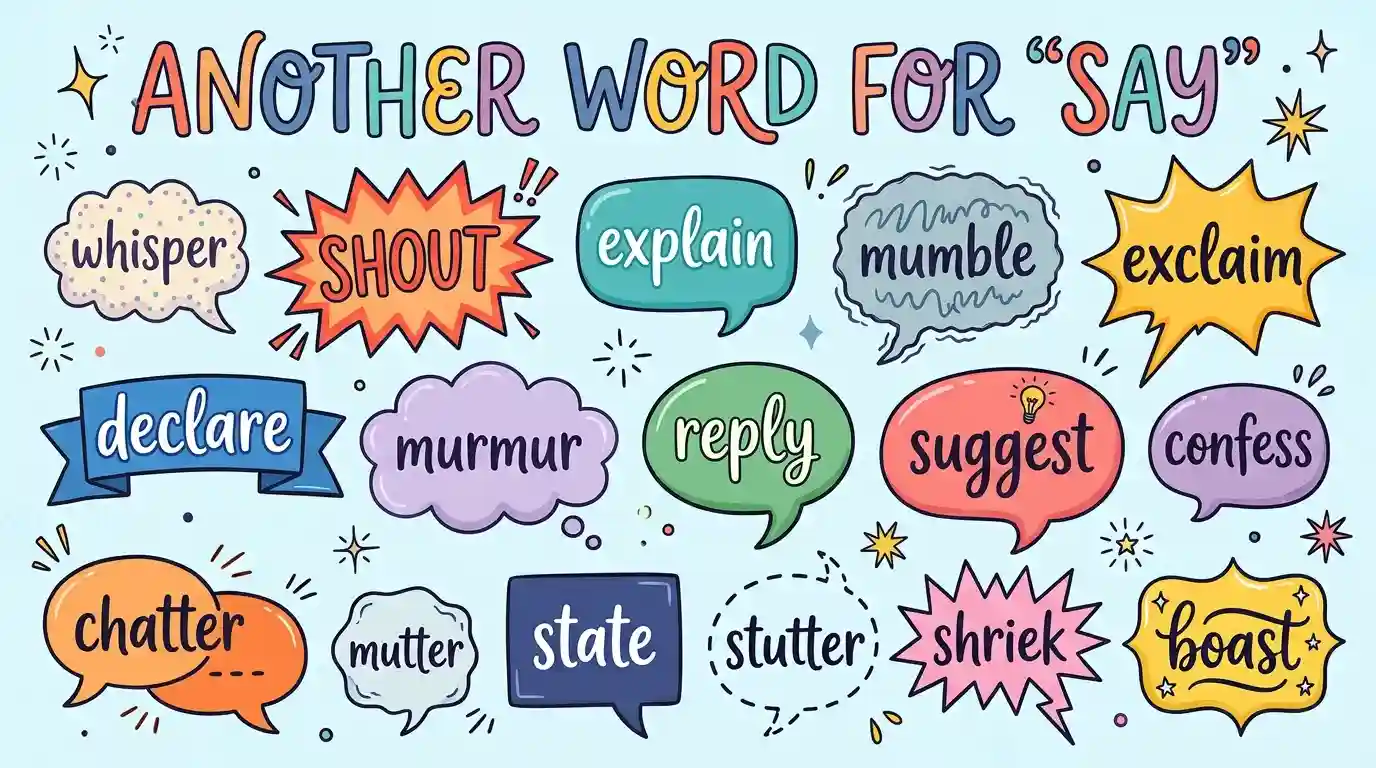
The closest everyday alternatives to “say” are tell, state, mention, remark, and add. For more formal writing, try to declare, announce, or assert. The best choice depends on what you mean. Do you want to speak aloud, share an opinion, report what a sign or rule shows, or make a guess?
“Say” is one of the most common verbs in English, so it can feel plain when you repeat it. Good alternatives can show how someone spoke (whisper, mutter, shout), how strongly they spoke (claim, affirm, assert), or what kind of statement it was (reply, comment, suggest).
Quick list: tell, state, mention, remark, add, declare, announce, reply, express, comment
Below, you will find 30 alternatives to “say,” each with its meaning, IPA, usage note, and example. The article also covers the different senses of “say,” common word partners, idioms, word history, and frequent mistakes.
At a Glance: Say Synonyms and Related Alternatives
| Alternative | Part of Speech | Meaning | Register / Tone | Ideal Context |
| Tell | Verb | Give information to someone | Neutral | Everyday speech; needs a listener |
| State | Verb | Say something clearly and formally | Formal | Reports, rules, official talk |
| Mention | Verb | Say something briefly | Neutral | Casual points that are not the main topic |
| Remark | Verb | Say something as a comment | Neutral to slightly formal | Short opinions or observations |
| Declare | Verb | Say something openly and firmly | Formal | Announcements, strong statements |
| Reply | Verb | Say something in answer | Neutral | Answering a question or message |
| Whisper | Verb | Say something very quietly | Neutral | Secrets, quiet places |
| Express | Verb | Show a thought or feeling in words | Neutral to formal | Feelings, opinions, ideas |
| Claim | Verb | Say something is true, often without proof | Neutral, can sound doubtful | News, disputes, arguments |
| Read | Verb | Show written words (for a sign or text) | Neutral | Signs, notes, meters |
Which Word Should You Use?
| If you want to… | Use | Why |
| Give information to a person | tell | It needs a listener: “tell her the news.” |
| Sound formal and clear | state | It suits reports and official language. |
| Make a small, passing point | mention | It suggests something brief, not detailed. |
| Share a quick opinion | remark or comment | Both show a short reaction to something. |
| Answer a question | reply or respond | Both link your words to what came before. |
| Show a quiet or angry tone | whisper, mutter | They describe how the words are spoken. |
| Say something is true, but you may not agree | claim | It signals that the statement may be doubted. |
| Describe what a sign or rule shows | read, indicate, specify | “Say” works too, but these are more exact. |
Exploring the Multiple Meanings of “Say”
1. Speak Words Aloud
- Meaning: To produce words with your voice.
- Explanation: This is the basic sense. The focus is on the words themselves, not on the person who hears them. That is why we say “say hello,” not “tell hello.”
- Example: She said good morning to everyone in the room.
2. Express an Idea, Opinion, or Fact
- Meaning: To state a thought, belief, or piece of information.
- Explanation: Here, “say” is about the content of what someone thinks or knows. Words like state, claim, and remark fit this sense.
- Example: He said that the plan was too risky.
3. Show Information in Writing or Signs
- Meaning: To give information through text, symbols, or instructions.
- Explanation: Things that cannot speak can still “say” something. Etymonline notes that this use with objects such as clocks and signs is not recorded before 1930.
- Example: The sign says the museum closes at five.
4. Suppose or Give an Example
- Meaning: To use “say” to introduce a guess or sample.
- Explanation: Common in phrases such as “let’s say” and “say, about fifty people.” It is informal and works like suppose or for example.
- Example: Let’s say you win a million dollars. What would you do?
5. The Right to Speak or Influence a Decision (Noun)
- Meaning: A person’s chance to give an opinion or help decide.
- Explanation: As a noun, “say” does not mean the act of speaking. It means influence, as in “have a say.”
- Example: Students should have a say in how the school spends its money.
Sources: Merriam-Webster; Collins Dictionary; Etymonline.
Analyzing 30 Say Alternatives in Detail
Some of these words are direct synonyms of “say,” while others fit only certain contexts, and each Usage note makes the difference clear.
Group 1: Everyday Core Alternatives
1. Tell
IPA: /tɛl/ (US and UK)
Definition: To give information or a message to someone in speech or writing.
- Usage: A close synonym of “say” in many sentences, but it usually needs a person who hears the information. Neutral and very common.
- Example: Please tell me what happened.
2. Speak
IPA: /spiːk/ (US and UK)
Definition: To say words aloud; to talk or give a talk.
- Usage: A related alternative. It describes the act of speaking more than the exact words, so it does not replace “say” before a quotation. Slightly more formal than “say.”
- Example: She spoke softly so the baby would not wake up.
3. Mention
IPA: /ˈmɛnʃən/ (US and UK)
Definition: To refer to something briefly or in passing.
- Usage: A close synonym when the point is short or not the main topic. Neutral.
- Example: He mentioned that he might be late.
4. Remark
IPA: US /rɪˈmɑːrk/ · UK /rɪˈmɑːk/
Definition: To say something as an observation or comment.
- Usage: A close synonym for short comments. Slightly more formal than “say” and common in reporting speech.
- Example: “It’s a nice day,” she remarked.
5. Add
IPA: /æd/ (US and UK)
Definition: To say something more after you have already spoken.
- Usage: A related alternative. It works only when something was said earlier, so it cannot start a conversation.
- Example: “And bring a coat,” he added.
6. State
IPA: /steɪt/ (US and UK)
Definition: To say or write something clearly, especially in a formal way.
- Usage: A close synonym in formal contexts such as reports, rules, and official talk. It can sound stiff in casual speech.
- Example: The report states that sales rose last year.
Group 2: Formal and Strong Statements
7. Declare
IPA: US /dɪˈklɛr/ · UK /dɪˈkleə/
Definition: To say something openly, firmly, or officially.
- Usage: A close synonym when the statement is strong or public. Formal. Do not use it for small remarks.
- Example: The mayor declared that the bridge would be rebuilt.
8. Announce
IPA: /əˈnaʊns/ (US and UK)
Definition: To make something known publicly.
- Usage: A related alternative for news or plans shared with a group. It suggests an audience, not a private chat.
- Example: The teacher announced the test results.
9. Assert
IPA: US /əˈsɜːrt/ · UK /əˈsɜːt/
Definition: To say something with confidence as if it were true.
- Usage: A close synonym in formal writing and debate. It shows firmness but does not prove the statement is correct.
- Example: She asserted that she had done nothing wrong.
10. Claim
IPA: /kleɪm/ (US and UK)
Definition: To say that something is true, often without giving proof.
- Usage: A related alternative. It often suggests that others may doubt the statement. Use it with care, because it can sound negative.
- Example: He claims that he never saw the message.
11. Affirm
IPA: US /əˈfɜːrm/ · UK /əˈfɜːm/
Definition: To say that something is true, or to state it firmly.
- Usage: A related alternative that adds strength or support. Formal.
- Example: The witness affirmed that she had seen the car.
12. Utter
IPA: US /ˈʌtər/ · UK /ˈʌtə/
Definition: To make a sound or say a word.
- Usage: A close synonym, but it sounds literary or dramatic. It is often used in negative sentences about silence.
- Example: He did not utter a single word during dinner.
Group 3: Answering and Manner of Speaking
13. Reply
IPA: /rɪˈplaɪ/ (US and UK)
Definition: To say or write something in answer.
- Usage: A related alternative. It needs something to answer, such as a question or message. Neutral.
- Example: “I’ll be there,” he replied.
14. Respond
IPA: US /rɪˈspɑːnd/ · UK /rɪˈspɒnd/
Definition: To answer or react in words or actions.
- Usage: A related alternative. It sounds more formal than “reply” and does not always mean speaking.
- Example: The company responded to the complaint within a day.
15. Whisper
IPA: US /ˈwɪspər/ · UK /ˈwɪspə/
Definition: To speak very quietly, using breath more than voice.
- Usage: A related alternative that shows manner. It suggests a secret or a need for quiet.
- Example: She whispered the answer to her friend.
16. Murmur
IPA: US /ˈmɜːrmər/ · UK /ˈmɜːmə/
Definition: To speak in a low, soft voice that is hard to hear.
- Usage: A related alternative. It often suggests a gentle or half-heard tone, and it can be slightly literary.
- Example: He murmured a few kind words as she fell asleep.
17. Shout
IPA: /ʃaʊt/ (US and UK)
Definition: To say something in a very loud voice.
- Usage: A related alternative that shows volume. It can show anger, excitement, or a need to be heard over noise.
- Example: “Watch out!” he shouted.
18. Mutter
IPA: US /ˈmʌtər/ · UK /ˈmʌtə/
Definition: To speak in a low voice, often because you are annoyed.
- Usage: A related alternative with a negative or unhappy tone. It is not a neutral synonym of “say.”
- Example: He muttered something about the traffic and left.
Group 4: Opinions, Ideas, and Feelings
19. Express
IPA: /ɪkˈsprɛs/ (US and UK)
Definition: To show a thought or feeling in words or actions.
- Usage: A related alternative. It focuses on feelings or ideas, and it is often followed by words like concern, thanks, or opinion.
- Example: She expressed her thanks to the team.
20. Voice
IPA: /vɔɪs/ (US and UK)
Definition: To say a thought or opinion openly.
- Usage: A related alternative. It often appears with concern, doubt, or opinion. Neutral to slightly formal.
- Example: Several parents voiced their worries about the new schedule.
21. Comment
IPA: US /ˈkɑːmɛnt/ · UK /ˈkɒment/
Definition: To give an opinion or a short remark about something.
- Usage: A related alternative. It needs a topic, usually with on or about. Common in news and online writing.
- Example: The coach declined to comment on the injury.
22. Observe
IPA: US /əbˈzɜːrv/ · UK /əbˈzɜːv/
Definition: To make a remark about something you have noticed.
- Usage: A related alternative. Formal and often written. Its main meaning is “to watch,” so context matters.
- Example: “You look tired,” she observed.
23. Suggest
IPA: US /səɡˈdʒɛst/ · UK /səˈdʒest/
Definition: To put forward an idea or plan for others to think about.
- Usage: A related alternative. It is softer than “say” and shows an idea, not a fact.
- Example: He suggested that we leave early.
24. Note
IPA: US /noʊt/ · UK /nəʊt/
Definition: To mention something because it is useful or worth attention.
- Usage: A related alternative common in reports and presentations. Formal to neutral.
- Example: The author notes that the numbers may change.
Group 5: Text, Signs, and Instructions
25. Read
IPA: /riːd/ (US and UK)
Definition: To have certain words written on it (used for signs, notes, and similar things).
- Usage: A close synonym of “say” in sense 3, but only for written text. Do not use it for spoken words.
- Example: The note read, “Back in ten minutes.”
26. Indicate
IPA: /ˈɪndɪkeɪt/ (US and UK)
Definition: To show or point to something.
- Usage: A related alternative for signs, results, and data. It is less direct than “say” and more formal.
- Example: The results indicate that the new method works better.
27. Specify
IPA: /ˈspɛsɪfaɪ/ (US and UK)
Definition: To state something exactly and clearly.
- Usage: A related alternative for rules, contracts, and instructions. It suggests exact detail.
- Example: The contract specifies a delivery date of June 1.
28. Stipulate
IPA: US /ˈstɪpjəleɪt/ · UK /ˈstɪpjʊleɪt/
Definition: To say that something must be done as a condition of an agreement.
- Usage: A related alternative with a narrow, formal meaning. It is limited to rules and contracts, so it is not a general synonym of “say.”
- Example: The rules stipulate that all players must wear helmets.
Group 6: Special Uses
29. Suppose
IPA: US /səˈpoʊz/ · UK /səˈpəʊz/
Definition: To imagine that something is true, or to guess.
- Usage: A close match for “say” in sense 4 (“let’s say”), not in the ordinary sense of speaking.
- Example: Suppose you had one extra hour each day. How would you use it?
30. Recite
IPA: /rɪˈsaɪt/ (US and UK)
Definition: To say aloud something you have learned by heart, such as a poem or list.
- Usage: A related alternative for words repeated from memory. It does not fit ordinary conversation.
- Example: The children recited the poem for their parents.
Sources: Merriam-Webster; Collins Dictionary and Thesaurus; Dictionary.com.
Say vs. Tell vs. Speak vs. Talk
These four verbs are related, but they follow different patterns.
| Verb | Main focus | Common pattern | Example |
| Say | The words spoken | say + words, or say (something) to someone | She said, “I’m ready.” |
| Tell | Giving information to a person | tell + person + information | She told me she was ready. |
| Speak | The act or ability of speaking | speak + language, or speak to/with someone | He speaks Spanish. |
| Talk | A conversation or informal speech | talk to/with someone, or talk about something | They talked for an hour. |
A useful rule is that “tell” nearly always needs a listener, while “say” does not. Also, “tell” is used in fixed phrases such as tell the truth, tell a lie, and tell a story, where “say” would sound wrong.
Sources: Merriam-Webster; Collins Dictionary.
Say and Opposite/Paired Word Pairs
| Word | Paired Word | Note |
| say | unsay | “Unsay” means to take back something said. It is rare and formal. |
| say | stay silent / keep quiet | The natural contrast: speaking versus not speaking. |
| say | ask | A statement versus a question. |
| say | do | Used in the common contrast between words and actions (see “easier said than done”). |
| say | hear | Linked in the pair of speaking and listening. |
| say | mean | What someone says may differ from what they mean. |
“Say” has no perfect single-word opposite, so these pairs show contrast or common association, not strict antonyms. The pair “say” and “unsay” is the nearest to a true opposite, but “unsay” is uncommon in daily English.
Sources: Merriam-Webster; Collins Dictionary; Etymonline.
Common Word Partners of “Say”
| Pattern | Common Partners | Example |
| say + greeting or polite phrase | hello, goodbye, thank you, sorry, please | He forgot to say thank you. |
| say + something/nothing | something, nothing, a few words, a word | She said nothing for a long time. |
| say + yes/no | yes, no, so | Just say yes! |
| say + a prayer/speech | a prayer, a few words, grace | They said a prayer before the meal. |
| say + adverb | clearly, quietly, softly, loudly | He said it quietly. |
| say + that | that + clause | She said that she was tired. |
| have/get a say | a say, a say in, the final say | Everyone should have a say in the decision. |
| let’s say / say, … | let’s say, say, for example | Let’s say it takes two hours. |
| to say the least | fixed phrase | The movie was strange, to say the least. |
Sources: Collins Dictionary; Merriam-Webster; Oxford Collocations Dictionary.
Idiomatic Phrases Featuring “Say”
1. It goes without saying
- Meaning: Something is so obvious that it does not need to be said.
- Example: It goes without saying that you should be on time.
2. You don’t say
- Meaning: A reply showing surprise. It is often used jokingly or with sarcasm when the news is obvious.
- Example: “It’s raining.” “You don’t say.”
3. You can say that again
- Meaning: A way of strongly agreeing with someone.
- Example: “This soup is great.” “You can say that again!”
4. Have the final say
- Meaning: To have the power to make the last decision. This is an established expression rather than a true idiom.
- Example: The manager has the final say on hiring.
Sources: Etymonline; Merriam-Webster; Collins Dictionary.
Word Formation of “Say”
Etymology & Structure
The modern verb comes from Middle English seien, which came from Old English secgan, meaning to speak, tell, or relate. It goes back to a Proto-Germanic verb that also gave German sagen and Dutch zeggen. “Say” is a short, simple word with no prefix or suffix. Older sources link the deeper Indo-European root to a base meaning “to say,” but the exact origin is debated.
Date and History
The verb is very old. It appears in Old English as secgan. The past tense said developed from Old English segde, and impersonal uses such as “it is said” were already found in Old English. The noun sense “what someone says,” and later “a statement,” is recorded in the 1570s according to Etymonline. The use of “say” for signs and clocks is not found before 1930.
Word Class Variations
- Verb: say, says, said, saying
- Noun: a say (“have a say”); saying (“an old saying”); say-so (“on his say-so”)
- Adjective: said (as in “the said person,” a formal or legal use meaning “mentioned before”)
- Related words: hearsay, gainsay, unsay, naysayer, soothsayer
“Say” has no regular adverb form.
Sources: Etymonline (entries for say, said, says); Merriam-Webster.
Common Word-Choice Mistakes
- He said me the news: He told me the news. (“Say” does not take a person directly after it.)
- She said to me to wait: She told me to wait.
- Say me the truth: Tell me the truth.
- He told, “I’m busy.”: He said, “I’m busy.” (“Tell” needs a listener.)
- She speaks a lie: She tells a lie.
- I’ll say you a story: I’ll tell you a story.
- She suggested me to go: She suggested that I go. (Or: She suggested going.)
FAQS
What is the closest synonym for “say”?
In everyday English, “tell” and “state” are the closest, though “tell” needs a listener and “state” is more formal.
What is a formal alternative to “say”?
“State,” “declare,” “assert,” and “specify” are common formal choices.
What is the difference between “say” and “tell”?
“Say” focuses on the words spoken. “Tell” focuses on giving information to someone, so it usually needs a person after it.
What word can show how someone spoke?
Use “whisper,” “murmur,” “shout,” or “mutter” to show volume and tone.
What is a good word for answering?
“Reply” and “respond” both work. “Reply” is more common in everyday speech.
Can “say” be used for signs and instructions?
Yes. We say “the sign says” or “the rules say.” You can also use “read,” “indicate,” or “state.”
What does “let’s say” mean?
It introduces a guess or example, similar to “suppose” or “for example.”
What is the opposite of “say”?
There is no exact opposite. “Unsay” means to take back what you said, and “stay silent” describes the contrast.
Is “claim” the same as “say”?
Not exactly. “Claim” often suggests that the statement may be doubted or has no proof.
Is “say” a noun too?
Yes. In phrases such as “have a say,” it means the right to give an opinion or share in a decision.
Conclusion
The closest everyday alternatives to “say” are “tell,” “state,” “mention,” “remark,” and “add.” For stronger or more formal statements, “declare,” “assert,” and “announce” are good choices.
The right word depends on context. Some words show how a person speaks (whisper, shout, mutter). Others show the purpose of the words (reply, comment, suggest). A few work only for text or rules (read, indicate, specify).
To choose well, ask three questions. Is there a listener? Is the tone formal or casual? Do you want to show volume, feeling, or purpose? The answers will point you to the best word.

I’m Rida, an SEO enthusiast with a strong interest in digital marketing and online growth.
I have 3 years of experience in web designing and office management.
I enjoy creating user-friendly websites and exploring effective SEO strategies.
My goal is to help websites grow through smart, creative, and result-driven digital solutions.