
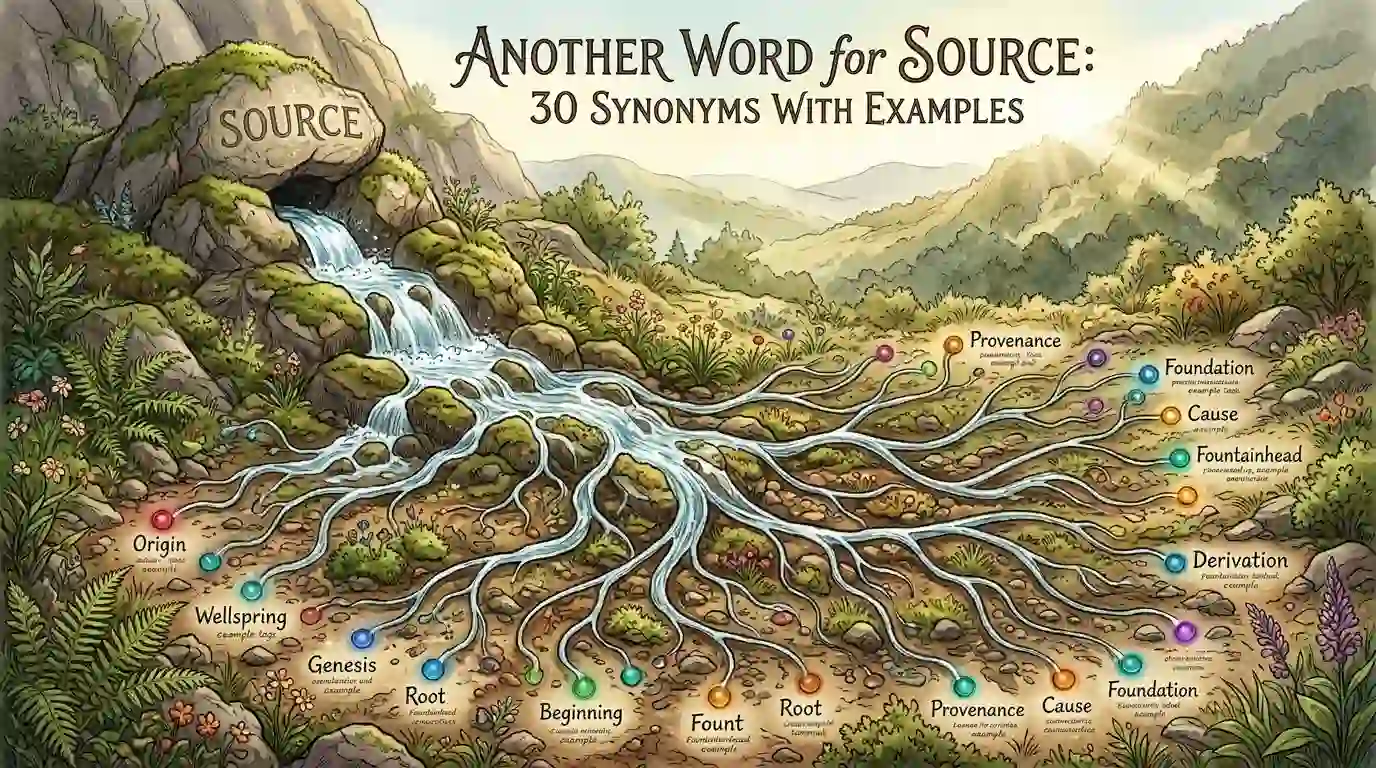
Another word for source is origin, supplier, or reference. These words match the main senses of source. A source can be a starting point, a supplier, or a person or text that gives facts.
The best choice depends on meaning and context. Use origin for starts, supplier for goods, and reference for facts. For the verb, try get or obtain.
Quick list: origin, root, cause, supplier, provider, reference, informant, document, spring, obtain
This article looks at 30 alternatives. Each entry gives a meaning, IPA, a usage note, and an example. You will also see the context where each word fits best.
At a Glance: Source Synonyms and Related Alternatives
| Alternative | Part of Speech | Meaning | Register / Tone | Ideal Context |
| origin | noun | The point where something starts | Neutral | Rivers, ideas, problems |
| supplier | noun | A seller of goods or parts | Neutral | Business and trade |
| provider | noun | A giver of a service or item | Neutral, modern | Services and care |
| reference | noun | A book or page you check | Neutral | Study and research |
| informant | noun | A person who gives facts | Formal | Police and research |
| document | noun | A written file used as proof | Neutral | Law and history |
| root | noun | The base cause of a problem | Neutral | Problems and causes |
| wellspring | noun | A rich supply of something | Literary | Ideas and feelings |
| authority | noun | An expert people trust | Formal | Facts and expertise |
| obtain | verb | To get something | Formal | Buying and trade |
Which Word Should You Use?
| If you want to… | Use | Why |
| Name where a river or idea starts | origin | It is plain and exact. |
| Find the base of a problem | root | It shows the deep cause. |
| Name a firm that sells you goods | supplier | It fits trade and business. |
| Name a person who gives a reporter facts | informant | It shows a person, not a text. |
| Point to a book you check for facts | reference | It fits study and research. |
| Name an old paper used as proof | document | It names a written record. |
| Praise a rich supply of ideas | wellspring | It sounds warm and literary. |
| Say you get goods from a seller | obtain | It works as a verb. |
Exploring the Multiple Meanings of “Source”
- Origin or Starting Point
- Meaning: The place or cause where something begins.
- Explanation: This sense fits rivers, ideas, and problems. It stresses the start of something.
- Example: Scientists traced the river to its source in the hills.
- Supply or Provider
- Meaning: A person, firm, or place that gives goods or power.
- Explanation: This sense is about supply. It fits food, water, income, and energy.
- Example: Solar panels are a clean source of energy.
- Provider of Information
- Meaning: A person, book, or site that gives facts.
- Explanation: Reporters, students, and writers use this sense often. A source can have a name or stay secret.
- Example: The reporter checked every source before she published the story.
- Original Record or Text
- Meaning: An original document or text used as proof or as a base.
- Explanation: Researchers talk about primary sources and source texts. In computing, source code is the code people write.
- Example: The historian read old letters as source material.
- To Get Goods (Verb)
- Meaning: To find and get goods from a supplier.
- Explanation: Business writers use this verb often. It stresses where goods come from.
- Example: The cafe sources its coffee beans from small farms.
Sources: Merriam-Webster, Collins Dictionary, Cambridge Dictionary, Dictionary.com.
Analyzing 30 Source Alternatives in Detail

Some alternatives are direct synonyms. Others are related words that fit only one sense.
Origin and Starting Point Alternatives
1. origin
IPA: US /ˈɔːrɪdʒɪn/ · UK /ˈɒrɪdʒɪn/
Definition: Means the point where something begins. It also shows where a person or thing comes from.
- Usage: It is the closest match for the starting-point sense. However, it does not fit the information sense.
- Example: Scientists study the origin of this rare disease.
2. root
IPA: /ruːt/ (US and UK)
Definition: Means the base cause or start of a problem. It also can mean the part of a plant below ground.
- Usage: It is common with problems. For example, people talk about the root of a conflict.
- Example: We need to find the root of the problem.
3. cause
IPA: /kɔːz/ (US and UK)
Definition: Means the thing that makes something happen. It also shows a reason for an event.
- Usage: It is a related alternative. However, it fits events and problems, not people or books.
- Example: Police are still looking for the cause of the fire.
4. wellspring
IPA: /ˈwɛlsprɪŋ/ (US and UK)
Definition: Means a rich and steady source of something. It also can mean a natural spring of water.
- Usage: It is literary and warm. Still, it suits ideas and feelings better than facts.
- Example: Her childhood was a wellspring of ideas for her stories.
5. fountainhead
IPA: /ˈfaʊntənhɛd/ (US and UK)
Definition: Means the first place a river or idea begins. It also shows the main source of power.
- Usage: It is formal and rare. In fact, it often fits ideas and movements.
- Example: Greece is often called the fountainhead of Western thought.
Supply and Provider Alternatives
6. supplier
IPA: US /səˈplaɪər/ · UK /səˈplaɪə/
Definition: Means a person or firm that sells goods to others. It also names a firm that sends parts to a maker.
- Usage: It is the best match for goods. For example, a shop buys stock from a supplier.
- Example: Our main supplier delivers fresh bread every morning.
7. provider
IPA: US /prəˈvaɪdər/ · UK /prəˈvaɪdə/
Definition: Means a person or group that gives a service or item. It also names a company that sells a service.
- Usage: It is a neutral, modern word. However, it fits services more than goods.
- Example: Her internet provider fixed the problem within an hour.
8. supply
IPA: /səˈplaɪ/ (US and UK)
Definition: Means an amount of something ready to use. It also can mean the act of giving it.
- Usage: It is a related alternative. In fact, it names the stock, not the place it comes from.
- Example: The village has a steady supply of clean water.
9. vendor
IPA: US /ˈvɛndər/ · UK /ˈvɛndə/
Definition: Means a person or firm that sells goods. It also can name a street seller.
- Usage: It is a related alternative. Still, it fits business and trade more than ideas.
- Example: The vendor sold fresh fruit from a cart near the station.
10. producer
IPA: US /prəˈduːsər/ · UK /prəˈdjuːsə/
Definition: Means a person or firm that makes goods or food. It also shows where a product starts.
- Usage: It is a related alternative. For example, a farm is a producer of milk.
- Example: The farm is a large producer of organic milk.
Information Source Alternatives
11. informant
IPA: US /ɪnˈfɔːrmənt/ · UK /ɪnˈfɔːmənt/
Definition: Means a person who gives facts to others. It also can name someone who tells police secrets.
- Usage: It fits police and research work. However, it can sound cold or sneaky.
- Example: The detective met his informant in a quiet cafe.
12. reference
IPA: /ˈrɛfrəns/ (US and UK)
Definition: Means a book, page, or person you check for facts. It also can mean a note that points to one.
- Usage: It is a good match for study. For example, a library has many reference books.
- Example: She kept a dictionary as a reference on her desk.
13. authority
IPA: US /əˈθɔːrəti/ · UK /ɔːˈθɒrəti/
Definition: Means an expert or book that people trust. It also can mean the power to make rules.
- Usage: It fits trusted experts. However, it has another sense of power.
- Example: She is a leading authority on desert plants.
14. contact
IPA: US /ˈkɑːntækt/ · UK /ˈkɒntækt/
Definition: Means a person you know who can give help or facts. It also shows a work link.
- Usage: It is a related alternative. In fact, reporters often call a source a contact.
- Example: My contact at the museum sent me the old photos.
15. insider
IPA: US /ɪnˈsaɪdər/ · UK /ɪnˈsaɪdə/
Definition: Means a person inside a group who knows private facts. It also can show close ties.
- Usage: It is a related alternative. Still, it often hints at secret facts.
- Example: An insider told the press about the company’s plans.
Document and Evidence Alternatives
16. document
IPA: US /ˈdɑːkjumənt/ · UK /ˈdɒkjʊmənt/
Definition: Means a written page or file that holds facts. It also can serve as proof.
- Usage: It fits papers and files. For example, a historian may cite a document as a source.
- Example: The lawyer read the document before she signed it.
17. record
IPA: US /ˈrɛkərd/ · UK /ˈrɛkɔːd/
Definition: Means a written or saved account of past events. It also can mean a file of facts.
- Usage: It fits history and law. However, it is a related alternative, not an exact match.
- Example: The school keeps a record of every student’s grades.
18. evidence
IPA: /ˈɛvɪdəns/ (US and UK)
Definition: Means facts or signs that show something is true. It also can mean items in a court case.
- Usage: It is a related alternative. In fact, a source can give evidence, but the two differ.
- Example: The report cites evidence from three different sources.
19. citation
IPA: /saɪˈteɪʃən/ (US and UK)
Definition: Means a note that names the book or page you used. It also can mean a short quote.
- Usage: It is a related alternative. However, a citation points to a source, not the source itself.
- Example: Each fact in her essay has a citation at the end.
20. archive
IPA: US /ˈɑːrkaɪv/ · UK /ˈɑːkaɪv/
Definition: Means a place or file that stores old records. It also can mean the records themselves.
- Usage: It is a related alternative. For example, researchers visit an archive to find old records.
- Example: The city archive holds maps from the early 1800s.
Figurative and Natural Alternatives
21. spring
IPA: /sprɪŋ/ (US and UK)
Definition: Means a place where water flows out of the ground. It also can mean a start of something.
- Usage: It is the literal match for water. However, it is not common for ideas.
- Example: The village gets its water from a mountain spring.
22. well
IPA: /wɛl/ (US and UK)
Definition: Means a deep hole that gives water. It also can mean a rich supply of something.
- Usage: It is common in figurative phrases. For example, people talk about a deep well of talent.
- Example: She drew on a deep well of patience.
23. mine
IPA: /maɪn/ (US and UK)
Definition: Means a place where people dig out ores. It also can mean a rich source of facts.
- Usage: It is a figurative match. In fact, people say a mine of information.
- Example: The old diary was a mine of facts about the town.
24. repository
IPA: US /rɪˈpɑːzətɔːri/ · UK /rɪˈpɒzɪtri/
Definition: Means a place where things are stored or kept. It also can mean a person with much knowledge.
- Usage: It is formal. However, it fits stores of data and knowledge better than origins.
- Example: The library is a repository of local history.
25. resource
IPA: US /ˈriːsɔːrs/ · UK /rɪˈzɔːs/
Definition: Means something you can use for help or supply. It also can mean a book or tool for study.
- Usage: It is a related alternative. For example, teachers share a resource with students.
- Example: The website is a great resource for new learners.
Verb Alternatives for “Source”
26. get
IPA: /ɡɛt/ (US and UK)
Definition: Means to come to have something. It also is the plainest choice in daily speech.
- Usage: It is plain and common. However, it sounds too casual for formal business texts.
- Example: We get our eggs from a farm down the road.
27. obtain
IPA: /əbˈteɪn/ (US and UK)
Definition: Means to get something with some effort. It also sounds more formal than get.
- Usage: It is a good match for the verb sense. For example, firms obtain parts from other firms.
- Example: The team will obtain the parts from a local maker.
28. procure
IPA: US /proʊˈkjʊr/ · UK /prəˈkjʊə/
Definition: Means to get something by careful effort. It also is common in business and law.
- Usage: It is a formal word. Still, it fits trade and buying very well.
- Example: The firm will procure new tools before the spring.
29. acquire
IPA: US /əˈkwaɪər/ · UK /əˈkwaɪə/
Definition: Means to come to own or gain something. It also can mean to learn a skill.
- Usage: It is a related alternative. However, it does not stress where an item comes from.
- Example: The museum plans to acquire a rare painting next year.
30. secure
IPA: US /sɪˈkjʊr/ · UK /sɪˈkjʊə/
Definition: Means to get something that is hard to win. It also can mean to make it safe.
- Usage: It is a related alternative. In fact, it stresses success in getting a thing.
- Example: She hopes to secure a good supplier for her new shop.
Sources: Merriam-Webster, Collins Dictionary, Cambridge Dictionary, Dictionary.com.
Types of Sources
| Type | Meaning | Example |
| Primary source | A first-hand record from the time | A diary, a letter, or a photo |
| Secondary source | A work that explains or studies primary sources | A history book |
| Tertiary source | A work that sums up many other sources | An encyclopedia |
| Anonymous source | A person whose name stays hidden | A person quoted in a news story |
The first three types show how close a source is to the events. The last type is about whether the name is public. Good writers check each type before they trust it.
Sources: Merriam-Webster, Collins Dictionary, Library of Congress (primary source guidance).
Source and Opposite/Paired Word Pairs
| Word | Paired Word | Note |
| source | mouth | For rivers: the source is the start, and the mouth is the end. |
| source | destination | For data and travel: where it starts and where it ends. |
| source | target | Used in language work: source language and target language. |
| source | sink | Used in science: a heat source and a heat sink. |
| primary source | secondary source | A common pair in research. |
Source has no single plain opposite. Each pair fits one field only. Pick the pair that matches your sense of source.
Sources: Merriam-Webster, Collins Dictionary, Cambridge Dictionary.
Common Word Partners of “Source”
| Pattern | Common Partners | Example |
| adjective + source | reliable, credible, trusted, anonymous, official | The article cites an anonymous source. |
| source + of | income, energy, information, inspiration, stress | Her garden is a source of joy. |
| noun + source | news, energy, data, food, light, water | Solar power is a clean energy source. |
| verb + source | cite, name, trace, check | Always check the source before you share a story. |
| source + noun | code, material, language, text | The writer used old letters as source material. |
Sources: Merriam-Webster, Collins Dictionary, Cambridge Dictionary.
Idiomatic Phrases Featuring “Source”

Source has few true idioms. These are established expressions that people use often.
- At source
- Meaning: At the point where something starts, before it spreads.
- Example: The company fixes errors at source, not at the end.
- Straight from the source
- Meaning: Directly from the person or place that knows best. It is informal.
- Example: I got the news straight from the source.
- Sources say
- Meaning: A news phrase for facts from people who stay unnamed.
- Example: Sources say the deal will close next week.
- Single source of truth
- Meaning: One main place where a team keeps the correct data. It is a tech phrase.
- Example: Our shared sheet is the single source of truth for the team.
Sources: Merriam-Webster, Collins Dictionary, Cambridge Dictionary.
Word Formation of “Source”
Etymology & Structure
Source comes from Old French sourse, which means a rising or a spring. That word comes from the verb sourdre, which comes from Latin surgere, meaning to rise. The English word is a single base with no prefix or ending.
Date and History
English took the word from Old French in the Middle Ages. Its first sense was the start of a stream or river. Check Etymonline for the exact first date.
Word Class Variations
- Noun: source, sourcing
- Verb: source (sourced, sourcing)
- Participial adjective: sourced, as in locally sourced
- Related derivatives: resource, outsource, crowdsource, open-source
Sources: Etymonline, Merriam-Webster, Collins Dictionary.
Common Word Choice Mistakes
- Tomato source: tomato sauce.
- The river’s resource is in the hills: the river’s source is in the hills.
- We sourced from local farms: we sourced our food from local farms.
- The source from the fire: the source of the fire.
- A source of informations: a source of information.
- A trust source: a trusted source.
Frequently Asked Questions
What is the closest synonym for source?
It depends on the sense. Origin fits a start, and supplier fits goods.
What is a good word for a source of information?
Reference, informant, and authority fit best. Each has a different tone.
What is a formal alternative?
Fountainhead and repository sound formal. For the verb, procure is formal.
What is a literary alternative?
Wellspring and fountainhead suit poetic or literary writing.
What is the difference between source and resource?
A source is where something comes from. A resource is something you can use.
Is source also a verb?
Yes. To source means to find and get goods from a supplier.
What is the opposite of source?
There is no single opposite. Mouth, destination, and target work in special cases.
Can source be used for people?
Yes. A person who gives facts to a reporter is a source.
What does source code mean?
Source code is the readable text of a program that people write.
Is source the same as sauce?
No. They mean different things, but some accents say them alike.
Conclusion
The closest alternatives to source are origin and supplier. Reference and informant fit facts. Get and obtain fit the verb.
Context decides the best word. Document and record fit evidence. Wellspring and mine fit figurative use.
First, find the sense you mean. Next, pick the word with the right tone. In short, small differences in meaning make your writing clearer.

Sarah Williams is an ESL teacher and content writer with a passion for simplifying English vocabulary. She creates easy-to-understand synonym guides and learning resources that help beginners and intermediate learners build strong language skills.