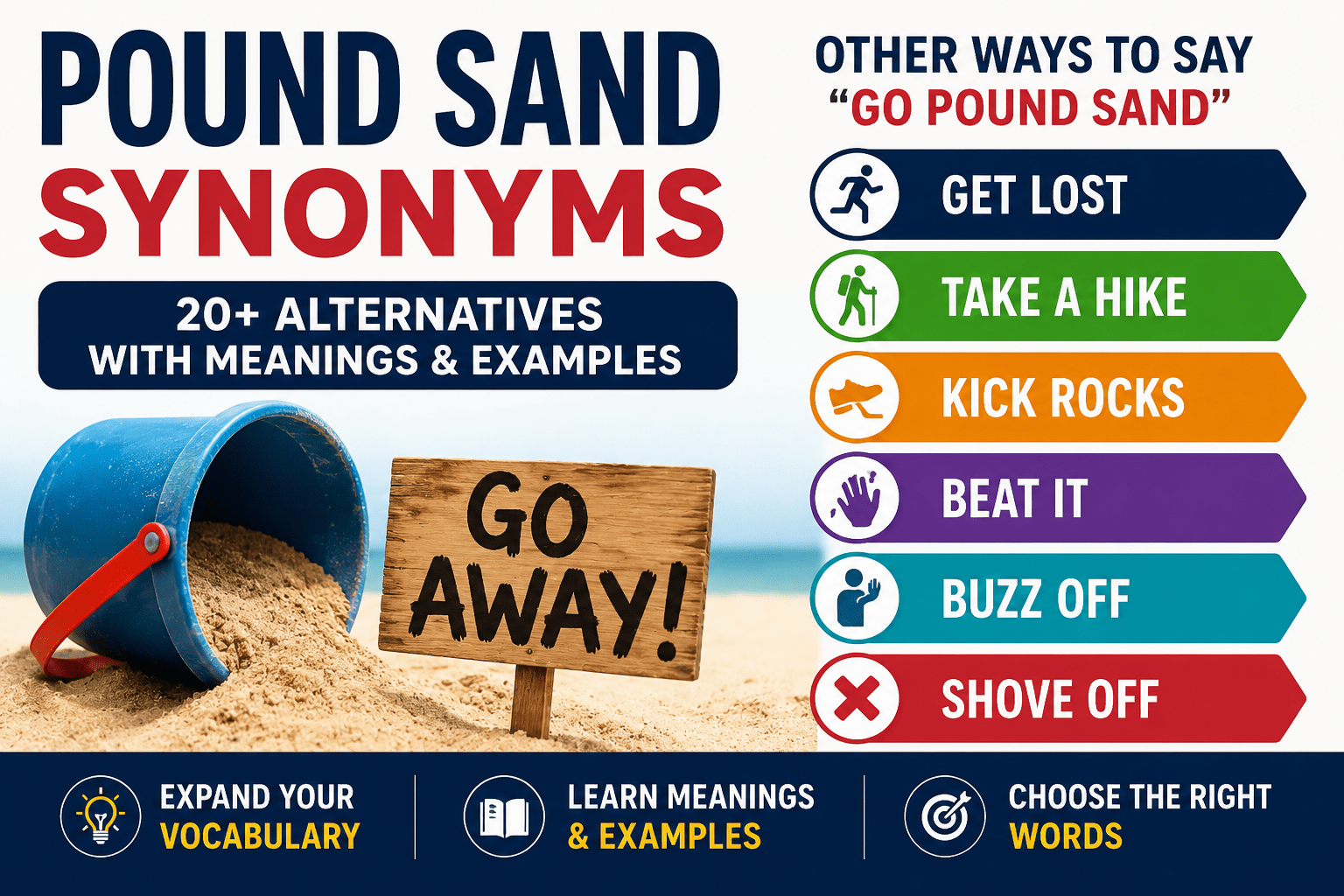
Looking for pound sand synonyms? The best alternative depends on which meaning of pound sand you have in mind.
When someone says “go pound sand,” they are usually dismissing another person and telling them to go away, get lost, or stop bothering them. It is an informal American expression with a deliberately rude or dismissive tone. Cambridge classifies “tell someone to pound sand” as US informal and defines it as telling someone forcefully and rudely to go away.
But pound sand can also describe doing something pointless or wasting time. Cambridge gives this broader meaning separately: doing something that has no purpose and wastes time.
That means the right synonym depends on whether you are dismissing a person or describing a futile activity.
Quick Answer: What Are the Best Pound Sand Synonyms?
For “go pound sand” meaning “go away,” useful alternatives include get lost, take a hike, beat it, buzz off, shove off, go away, leave me alone, and kick rocks.
For the sense of doing something pointless, alternatives include waste time, act futilely, do something pointless, labor in vain, and engage in a fruitless activity.
The closest replacement depends on tone. Get lost is direct and informal, take a hike is dismissive but often somewhat playful, while leave me alone is much more neutral. None is a perfect synonym in every context.
Pound Sand Synonyms at a Glance
| Word or Phrase | Relationship | Meaning | Tone | Best Context |
|---|---|---|---|---|
| Get lost | Close alternative | Go away | Rude/direct | Dismissing someone |
| Take a hike | Close alternative | Go away | Informal/dismissive | Casual speech |
| Kick rocks | Close alternative | Go away | Informal/rude | Casual American English |
| Beat it | Close alternative | Leave | Informal/direct | Telling someone to leave |
| Buzz off | Close alternative | Go away | Informal | Annoyance |
| Shove off | Close alternative | Go away | Informal/rude | Dismissal |
| Go away | Neutral alternative | Leave | Neutral/direct | General use |
| Leave me alone | Contextual alternative | Stop bothering me | Direct/neutral | Personal boundaries |
| Hit the road | Contextual alternative | Leave | Informal | Telling someone to depart |
| Scram | Contextual alternative | Leave quickly | Informal | Strong dismissal |
| Begone | Contextual alternative | Go away | Archaic/dramatic | Literary or humorous use |
| Go to hell | Related alternative | Leave / rejection | Very rude | Strong anger |
| Sod off | Regional alternative | Go away | Vulgar/informal | British English |
| Buzz off | Close alternative | Go away | Informal | Casual dismissal |
| Shove off | Close alternative | Go away | Rude | Strong dismissal |
| Waste time | Contextual alternative | Spend time pointlessly | Neutral | Futile activity |
| Act pointlessly | Contextual alternative | Do something without purpose | Neutral | General description |
| Labor in vain | Near alternative | Work without achieving a result | Formal/literary | Writing |
| Work to no purpose | Contextual alternative | Work without useful result | Formal | Professional writing |
| Engage in a futile activity | Contextual alternative | Do something pointless | Formal | Academic/professional writing |
What Does “Pound Sand” Mean?
Pound sand is an idiomatic expression with two important uses.
1. “Go pound sand” = go away
When used as a command, go pound sand means roughly go away, get lost, or stop bothering me. It is informal and deliberately dismissive. Cambridge describes it as a forceful and rude way of telling someone to go away.
Example:
If you don’t like my decision, you can go pound sand.
Here, the speaker is dismissing the other person’s objection.
2. “Pound sand” = do something pointless
The expression can also describe an activity that is futile, purposeless, or a waste of time.
Example:
Without the necessary equipment, we’ll just be pounding sand.
Here, the phrase does not directly tell another person to leave. It means the activity would accomplish nothing.
This distinction is important when choosing a synonym.
Synonyms for “Go Pound Sand”
1. Get Lost
Get lost is one of the closest everyday alternatives to go pound sand when you are telling someone to leave.
If you’re going to keep complaining, get lost.
It is direct, informal, and rude, although generally less colorful than go pound sand.
Best for:
- arguments
- casual conversations
- dismissing someone
- unwanted interruptions
Tone:
Rude and direct
2. Take a Hike
Take a hike means go away or leave and is often less aggressive than some stronger dismissive expressions.
He kept interrupting us, so I finally told him to take a hike.
It can sound irritated, playful, or sarcastic depending on the situation.
Choose it when:
You want an informal dismissal without using profanity.
3. Kick Rocks
Kick rocks is an informal expression meaning roughly go away or get lost.
If they don’t like the rules, they can kick rocks.
It overlaps strongly with go pound sand, particularly in casual American English.
Important distinction
Kick rocks focuses more directly on leaving, while pound sand can additionally suggest that the person should occupy themselves with something pointless.
4. Beat It
Beat it is a short, direct way of telling someone to leave.
Beat it. I’m trying to work.
It is informal and can sound harsh depending on delivery.
Best context:
Short, direct dialogue.
5. Buzz Off
Buzz off means go away or stop bothering me.
Buzz off and let me finish this.
It is informal and dismissive but is often less severe than profanity-based expressions.
Best for:
Casual conversations and situations involving annoyance.
6. Shove Off
Shove off is another informal way of telling someone to leave.
He told the reporters to shove off.
It is more confrontational than a simple go away.
7. Go Away
Go away is the simplest neutral alternative.
Please go away and give me some time.
Unlike go pound sand, it does not inherently carry the same sarcastic or colorful quality.
Choose go away when:
You need clarity without deliberately sounding insulting.
8. Leave Me Alone
Leave me alone is particularly useful when the real meaning is stop bothering me rather than simply leave this place.
Please leave me alone. I need some time to think.
This is often a much better choice than go pound sand when communicating a boundary without unnecessary hostility.
9. Hit the Road
Hit the road is an informal expression meaning leave or depart.
It’s getting late, so we’d better hit the road.
It is not always a hostile expression. Unlike go pound sand, it can simply refer to departing.
Therefore:
Hit the road is a contextual alternative, not a perfect synonym.
10. Scram
Scram means leave quickly, usually because the speaker wants someone gone.
Scram before the manager sees you here.
It has a strongly informal, sometimes old-fashioned or playful flavor.
Alternatives for the “Pointless Activity” Meaning
Not every synonym for go pound sand works for the second meaning.
When pound sand means doing something futile, use expressions that describe wasted effort.
Waste Time
We’re wasting time arguing about something we can’t change.
This is one of the clearest neutral alternatives.
Do Something Pointless
There’s no reason to keep doing something pointless.
This expresses the meaning directly without the idiomatic flavor.
Labor in Vain
Labor in vain means to work without achieving the desired result.
They labored in vain to repair the damaged system.
This is more formal and literary than pound sand.
Work to No Purpose
Continuing the project without funding would be working to no purpose.
This works well in formal writing.
Engage in a Futile Activity
Repeating the same failed experiment would be engaging in a futile activity.
This is particularly appropriate for academic or professional contexts.
Which Pound Sand Synonym Should You Use?
Choose get lost when:
You want a direct, familiar way to tell someone to leave.
Choose take a hike when:
You want an informal, dismissive expression that can sound somewhat playful.
Choose kick rocks when:
You want a casual American expression with a similar dismissive flavor.
Choose beat it when:
You want a short and forceful command to leave.
Choose buzz off when:
Someone is annoying you and you want them to stop bothering you.
Choose leave me alone when:
You want to communicate a boundary rather than simply insult someone.
Choose go away when:
You want the clearest and least idiomatic expression.
Choose waste time when:
You are describing a futile activity rather than telling someone to leave.
Choose labor in vain when:
You need a more formal or literary expression for unsuccessful effort.
Pound Sand vs. Get Lost
These expressions overlap, but they are not identical.
| Pound Sand | Get Lost | |
| Core meaning | Go away / occupy yourself with something pointless | Go away |
| Register | US informal | Informal |
| Tone | Rude, dismissive | Rude/direct |
| Figurative element | Strong | Limited |
| Can describe futile activity? | Yes | No |
| Best use | Colorful dismissal | Direct dismissal |
Cambridge specifically identifies tell someone to pound sand as a US informal expression for telling someone forcefully and rudely to go away.
Pound Sand vs. Take a Hike
Take a hike is generally a close functional alternative when the intended meaning is simply leave.
Go pound sand.
Take a hike.
Both can dismiss someone, but pound sand has a stronger suggestion that the person should occupy themselves with something pointless.
Pound Sand vs. Kick Rocks
Kick rocks and go pound sand are both informal dismissive expressions.
If you don’t like the offer, go pound sand.
If you don’t like the offer, kick rocks.
The second sentence works naturally in casual American English, but the expressions are not completely interchangeable in every context.
Polite Alternatives to “Pound Sand”
If you need to tell someone to leave without sounding unnecessarily rude, avoid simply replacing pound sand with another rude idiom.
Better options include:
- Please leave.
- I’d like some privacy.
- Please give me some space.
- I’d prefer not to continue this conversation.
- Please stop bothering me.
- I think it’s best if you leave.
- I’d appreciate some time alone.
These are not strict synonyms, but they communicate the underlying intention in a more appropriate way.
Common Mistakes With “Pound Sand” Synonyms
Mistake 1: Treating every “go away” phrase as identical
Expressions such as get lost, take a hike, and go pound sand overlap, but their tone and implied attitude differ.
Mistake 2: Using “waste time” as a direct synonym for “go pound sand”
Waste time describes an activity. It does not normally function as a command meaning “go away.”
Mistake 3: Using “go pound sand” in formal writing
The expression is informal and rude. It is usually inappropriate for professional correspondence, academic writing, customer service, or formal reports.
Mistake 4: Assuming “pound sand” always means “go away”
It can also describe an activity that is pointless or wasteful. Context determines the intended meaning.
Mistake 5: Confusing “pound sand” with a literal instruction
The phrase is idiomatic. Its figurative meaning cannot be understood simply by combining the literal meanings of pound and sand.
Is “Pound Sand” Rude?
Yes, generally.
When you tell someone to “go pound sand,” you are dismissing them in a forceful and rude way. Cambridge explicitly labels the expression US informal and describes it as telling someone to go away forcefully and rudely.
It can be humorous between friends, but that does not make it appropriate in every situation.
For professional communication, choose a neutral alternative such as:
Please leave me alone.
or:
I’d prefer to end the conversation here.
Pronunciation
pound sand
US: /paʊnd sænd/
The phrase has two one-syllable words, with the main stress naturally falling on pound.
FAQ About Pound Sand Synonyms
What is another word for “pound sand”?
If pound sand means go away, alternatives include get lost, take a hike, kick rocks, beat it, buzz off, shove off, and go away. If it means do something pointless, alternatives include waste time, work to no purpose, and labor in vain.
What is a polite way to say “pound sand”?
A polite alternative is “Please leave,” “Please give me some space,” “I’d like some privacy,” or “I’d prefer not to continue this conversation.” These expressions communicate the desired boundary without the deliberately rude tone of go pound sand.
Is “get lost” the same as “pound sand”?
They are close when both are used to dismiss someone. Get lost directly tells someone to leave, while pound sand adds a more colorful suggestion that the person should occupy themselves with something pointless. Both are informal and can sound rude.
Is “kick rocks” a synonym for “pound sand”?
Kick rocks is a close contextual alternative to go pound sand when both mean “go away.” However, it is not a synonym for every use of pound sand, particularly when pound sand describes a futile activity.
What does “go pound sand” mean?
Go pound sand is a US informal expression used to tell someone forcefully and rudely to go away. It can also carry the idea that the person should occupy themselves with something pointless rather than bothering the speaker.
Can I use “pound sand” in professional writing?
Usually, no. Because the expression is informal and dismissive, it can sound hostile or unprofessional. In formal writing, use clearer alternatives such as reject the request, decline, refuse, dismiss the proposal, or ask the person to leave, depending on the intended meaning.
What is the difference between “pound sand” and “take a hike”?
Both can tell someone to leave, but pound sand is more strongly associated with dismissing someone and suggesting that they occupy themselves with a pointless task. Take a hike is also informal but can sound more playful or less hostile.
Conclusion
The best pound sand synonyms depends on what you mean.
For the dismissive command “go pound sand,” the closest alternatives include get lost, take a hike, kick rocks, beat it, buzz off, and shove off. For a less hostile expression, use go away or leave me alone.
When pound sand means doing something futile, use alternatives such as waste time, work to no purpose, engage in a futile activity, or labor in vain.
The key is not to choose the phrase that merely looks similar in a thesaurus. Choose the expression that matches the intended meaning, tone, register, and context.

Emily Johnson is a linguistics graduate and vocabulary specialist. She writes detailed synonym explanations and helps readers understand subtle differences between words, improving both writing and speaking skills. Synonyms help express ideas more clearly and precisely in English.