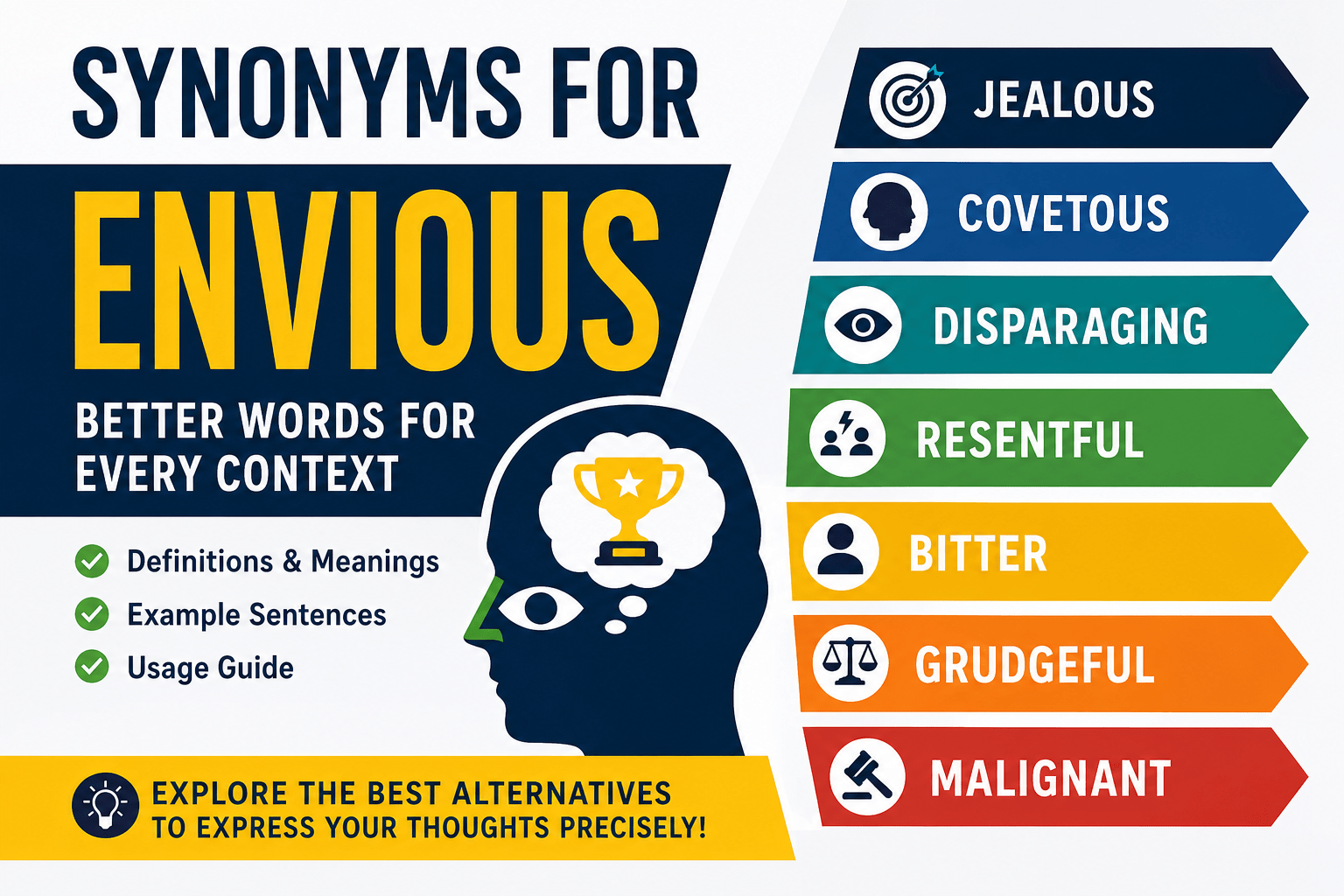
If you are looking for synonyms for envious, the best alternatives include jealous, covetous, resentful, begrudging, grudging, green-eyed, and green with envy. However, these words are not interchangeable in every situation. Covetous emphasizes wanting what someone else has, resentful emphasizes bitterness about another person’s advantage, and jealous can mean envious in everyday English but also has a distinct sense related to protecting a relationship or possession.
This guide explains the most useful alternatives to envious, how their meanings differ, which ones are formal or informal, and which word sounds most natural in different contexts.
Quick Answer: What Are the Best Synonyms for Envious?
The closest and most useful alternatives to envious are:
- Jealous — commonly used for wanting what someone else has; also has a distinct relationship-related meaning.
- Covetous — strongly focused on wanting another person’s possessions or advantages; often formal or disapproving.
- Resentful — emphasizes bitterness toward someone because of their advantage.
- Grudging — suggests reluctant or unwilling admiration or acceptance.
- Begrudging — emphasizes reluctance to allow another person the success, praise, or benefit they have.
- Green-eyed — an informal, figurative expression associated with jealousy or envy.
- Green with envy — an idiomatic expression meaning extremely envious.
- Desirous — emphasizes wanting something, but does not necessarily carry the negative emotional force of envious.
- Spiteful — stronger and more hostile; use it only when envy is accompanied by a desire to hurt or obstruct someone.
- Malicious — much stronger than envious and appropriate only when harmful intent is involved.
Not all of these are exact synonyms. The best choice depends on whether you want to emphasize desire, resentment, hostility, intensity, or informal tone.
What Does “Envious” Mean?
Envious is an adjective describing someone who wants something another person has or wishes to be in a similar situation. Oxford defines it as wanting to be in the same situation as somebody else or wanting something that somebody else has.
For example:
She was envious of her colleague’s promotion.
The adjective commonly appears in the structure envious of + person/thing:
- envious of her success
- envious of his lifestyle
- envious of their opportunities
- envious of someone’s talent
Merriam-Webster likewise defines envious as feeling or showing envy and gives examples involving another person’s possessions and advantages.
Pronunciation: /ˈen.vi.əs/ (US and UK)
Best Synonyms for Envious at a Glance
| Word | Relationship | Main Meaning | Tone/Formality | Best Context |
|---|---|---|---|---|
| Jealous | Very close | Wanting what another has; also fear of losing what one has | Neutral | Everyday English |
| Covetous | Near synonym | Strong desire for another’s possessions or advantages | Formal, often negative | Writing, moral criticism |
| Resentful | Near synonym | Bitter about another person’s advantage | Neutral | Success, unfairness, treatment |
| Grudging | Contextual | Reluctant to give or acknowledge something | Neutral/formal | Praise, acceptance, admiration |
| Begrudging | Contextual | Reluctant to let someone have credit or success | Neutral | Recognition, success |
| Green-eyed | Idiomatic | Affected by envy or jealousy | Informal | Conversational writing |
| Green with envy | Idiomatic | Extremely envious | Informal/expressive | Everyday speech |
| Desirous | Partial synonym | Wanting something | Formal | Neutral desire |
| Spiteful | Stronger related word | Wanting to hurt or upset someone | Negative | Hostile behavior |
| Malicious | Stronger related word | Intending harm | Strong/formal | Harmful actions or motives |
The classification matters because dictionaries often provide broad synonym lists containing words with different shades of meaning. Collins, for example, lists covetous, jealous, grudging, malicious, and resentful among alternatives associated with envious.
15 Synonyms and Alternatives for Envious
1. Jealous
Jealous is probably the closest everyday alternative to envious. Merriam-Webster notes that both words commonly describe a strong desire for something belonging to someone else.
Example:
I’m jealous of her new apartment.
However, jealous has another important meaning: being protective of something you have because you fear someone else may take it or replace you.
Example:
He became jealous when his partner started spending more time with a coworker.
Best choice when:
You are writing naturally in everyday English or describing relationship-related insecurity.
2. Covetous
Covetous describes a strong desire to possess something that belongs to someone else. It is more formal and usually carries a negative judgment.
Example:
His covetous attitude toward his neighbor’s wealth was obvious.
Choose covetous when you want to emphasize possession and desire, rather than simply feeling unhappy about another person’s success.
Best choice when:
Writing formally, critically, or about material possessions.
3. Resentful
Resentful is not a perfect synonym for envious. It focuses more on bitterness or anger caused by another person’s advantage or treatment.
Example:
She felt resentful when her colleague received the promotion.
Compare:
She was envious of her colleague’s promotion.
This means she wanted the success.
She was resentful about her colleague’s promotion.
This suggests she felt bitter or wronged by it.
Best choice when:
The emotion includes bitterness, unfairness, or dissatisfaction.
4. Grudging
Grudging suggests reluctance, especially when someone does not willingly give another person praise, approval, or acknowledgment.
Example:
He offered a grudging compliment after seeing her performance.
It can overlap with envy when someone reluctantly recognizes another person’s success, but it should not automatically replace envious.
Best choice when:
The emphasis is on reluctant acknowledgment.
5. Begrudging
Begrudging is closely related to grudging and often suggests reluctance to allow someone else to have something positive, such as success, credit, or praise.
Example:
She gave her rival a begrudging admission of success.
Best choice when:
Someone reluctantly gives another person credit or accepts their advantage.
6. Green-Eyed
Green-eyed is an informal figurative alternative associated with envy or jealousy.
Example:
His green-eyed reaction was obvious when he saw their new house.
It is more expressive than envious and works especially well in creative or conversational writing.
Best choice when:
You want a colorful, idiomatic expression.
7. Green With Envy
Green with envy means extremely envious.
Example:
She was green with envy when she saw her friend’s new car.
This is not a single-word synonym, but it is an excellent phrase-level alternative when you want to emphasize intensity.
Best choice when:
You want a vivid, informal expression for strong envy.
8. Desirous
Desirous means wanting something strongly. It can overlap with envious, but it does not necessarily imply resentment toward another person.
Example:
He was desirous of the opportunities available to his colleagues.
Because desirous is broader, it should not replace envious when the negative comparison with another person is important.
Best choice when:
The emphasis is simply on strong desire.
9. Spiteful
Spiteful means showing a desire to hurt, annoy, or upset someone. It is therefore considerably stronger than envious.
Example:
His spiteful remarks seemed motivated by resentment.
Being envious does not automatically make someone spiteful.
Best choice when:
Envy has developed into deliberate hostility or harmful behavior.
10. Malicious
Malicious describes an intention to cause harm. It is not a direct synonym for envious.
Example:
The malicious rumor damaged her reputation.
A person can be envious without being malicious, so use this word only when harmful intent is genuinely present.
Best choice when:
You need to describe deliberate harmful intent, not ordinary envy.
11. Resentful of
This phrase is useful when the important part of the emotion is bitterness toward someone’s advantage.
Example:
He became resentful of his brother’s success.
It is especially natural when the person feels that another individual’s success is undeserved.
12. Begrudging
In some contexts, begrudging is particularly effective for describing someone who does not willingly accept another person’s success or recognition.
Example:
She offered a begrudging acknowledgment of his achievement.
This is more precise than simply saying envious when reluctant recognition is the central idea.
13. Grudgingly Admiring
This phrase can be useful when someone envies another person’s ability while recognizing that the achievement is impressive.
Example:
He was grudgingly admiring of her ability to solve the problem.
It expresses a mixed response: admiration combined with reluctance or envy.
14. Bitter
Bitter can describe a person who is deeply angry, resentful, or unhappy because of another person’s success or circumstances.
Example:
Years of professional disappointment left him bitter toward more successful colleagues.
However, bitter is broader and usually stronger than envious.
Best choice when:
The feeling has become persistent resentment or anger.
15. Coveting
Coveting emphasizes strongly wanting something another person possesses.
Example:
He was openly coveting his neighbor’s expensive sports car.
It is particularly useful when the focus is on desire for possession rather than emotional resentment.
Envious vs. Jealous: What Is the Difference?
This is the most important comparison to understand.
Envious traditionally focuses on wanting something that another person has.
Jealous has overlapping everyday usage, but it can also describe fear that something you already have—especially a relationship—may be threatened by another person. Merriam-Webster explicitly recognizes both uses.
| Situation | Better word |
| You want someone’s new car | Envious |
| You want someone’s success | Envious |
| You want someone’s talent | Envious |
| You fear losing your partner to someone else | Jealous |
| You casually wish you had someone’s vacation | Jealous is common in conversation |
| You want another person’s possessions | Envious or covetous |
Simple rule
Think:
Envy → “I want what you have.”
Jealousy → “I don’t want to lose what I have.”
This distinction is useful, although real-world English frequently overlaps the two words. Current dictionary usage recognizes that jealous can also mean envious.
Envious vs. Covetous
Both words can describe wanting something another person has.
The difference is mainly one of strength, focus, and register.
- Envious — focuses on the emotional reaction to another person’s advantage.
- Covetous — focuses more strongly on the desire to possess what belongs to another.
Envious:
She was envious of her friend’s success.
Covetous:
He cast a covetous glance at the expensive watch.
Choose covetous when possession or acquisitive desire is central.
Envious vs. Resentful
These words overlap but emphasize different emotions.
Envious = wanting what someone else has.
Resentful = feeling bitterness or anger about someone’s advantage or treatment.
Compare:
I was envious of her promotion.
You wanted the promotion.
I was resentful about her promotion.
You may believe the promotion was unfair or undeserved.
Which Word Should I Use?
Use envious when:
You want the most direct, neutral description of wanting something another person has.
Use jealous when:
You are writing naturally in everyday English, or the situation involves fear of losing a relationship or possession.
Use covetous when:
You want to emphasize strong desire for another person’s possessions or advantages.
Use resentful when:
The emotion includes bitterness or a sense of unfairness.
Use grudging when:
Someone reluctantly acknowledges another person’s achievement or quality.
Use green with envy when:
You want an expressive, informal phrase for intense envy.
Use spiteful when:
The person is acting with a desire to hurt or annoy someone.
Use malicious when:
There is clear intent to cause harm.
Common Mistakes With “Envious” Synonyms
1. Treating every related word as an exact synonym
Words such as spiteful, bitter, and malicious can be associated with envy, but they add meanings that envious does not necessarily contain.
2. Assuming “jealous” and “envious” are always identical
They overlap substantially in modern usage, but jealous also has a distinct sense involving fear of losing something or someone.
3. Using “resentful” when you only mean “wanting”
If someone admires another person’s success and wishes they had similar success, envious is usually more precise.
4. Using “malicious” for ordinary envy
Someone can feel envious without intending to harm anyone. Malicious introduces deliberate harmful intent.
5. Using “covetous” in casual conversation
Covetous is legitimate, but it often sounds more formal or morally judgmental than everyday envious.
Common Collocations With “Envious”
Natural phrases include:
- envious of someone
- envious of someone’s success
- envious of someone’s wealth
- envious of someone’s talent
- envious of someone’s lifestyle
- an envious look
- an envious glance
- envious eyes
- feel envious
- become envious
- extremely envious
Oxford specifically records the common pattern envious of somebody/something and examples involving success and opportunities. Collins also records expressions such as envious eye and envious glances.
FAQ: Synonyms for Envious
What is the closest synonym for envious?
Jealous is one of the closest everyday alternatives because the two words overlap substantially in modern English. However, jealous also has a distinct meaning involving fear of losing a relationship or possession, so envious is more precise when someone simply wants what another person has.
What is a stronger word than envious?
Covetous can emphasize a strong desire for another person’s possessions, while resentful, bitter, or spiteful may be stronger when envy includes bitterness or hostility. Malicious is stronger still, but it means intending harm rather than simply feeling envy.
Is jealous a synonym for envious?
Yes, jealous is commonly used as a synonym for envious, particularly in everyday English. However, jealous also has a separate sense involving fear that another person may threaten a relationship or something you possess.
What is a formal synonym for envious?
Covetous is one of the strongest formal alternatives. It emphasizes a strong desire to possess something another person has and often carries a disapproving tone. Cambridge also lists covetous among words associated with envious.
What is a polite way to say envious?
If you want to sound less negative, admiring or wishing I had something similar may work depending on the context. However, these are not exact synonyms: admiration can be positive, whereas envious specifically expresses desire for another person’s advantage.
What is the difference between envious and covetous?
Envious focuses on the emotional response to another person’s advantage, while covetous more strongly emphasizes wanting to possess what another person has. Covetous also tends to sound more formal and disapproving.
Can envious be positive?
Envy is normally a negative or uncomfortable emotion, but it does not necessarily involve hostility. Someone may feel envious of another person’s success while also admiring that person. The context determines whether the feeling is mild, resentful, or malicious.
Conclusion
The best synonym for envious depends on exactly what you want to communicate. Use jealous for a common everyday alternative, covetous when strong desire for another person’s possessions is important, resentful when bitterness is central, and green with envy for a vivid informal expression.
The key is not to choose the most sophisticated-looking synonym. Choose the word that preserves the meaning, emotional tone, and context of the original sentence. That distinction is what turns a basic thesaurus list into useful vocabulary guidance.

Michael Thompson is an English language specialist and experienced editor who focuses on vocabulary development and clear communication. He creates high-quality synonym guides, word comparisons, and writing tips to help students and professionals express their ideas more effectively. His work combines linguistic knowledge with practical SEO strategies to make learning both useful and engaging.