
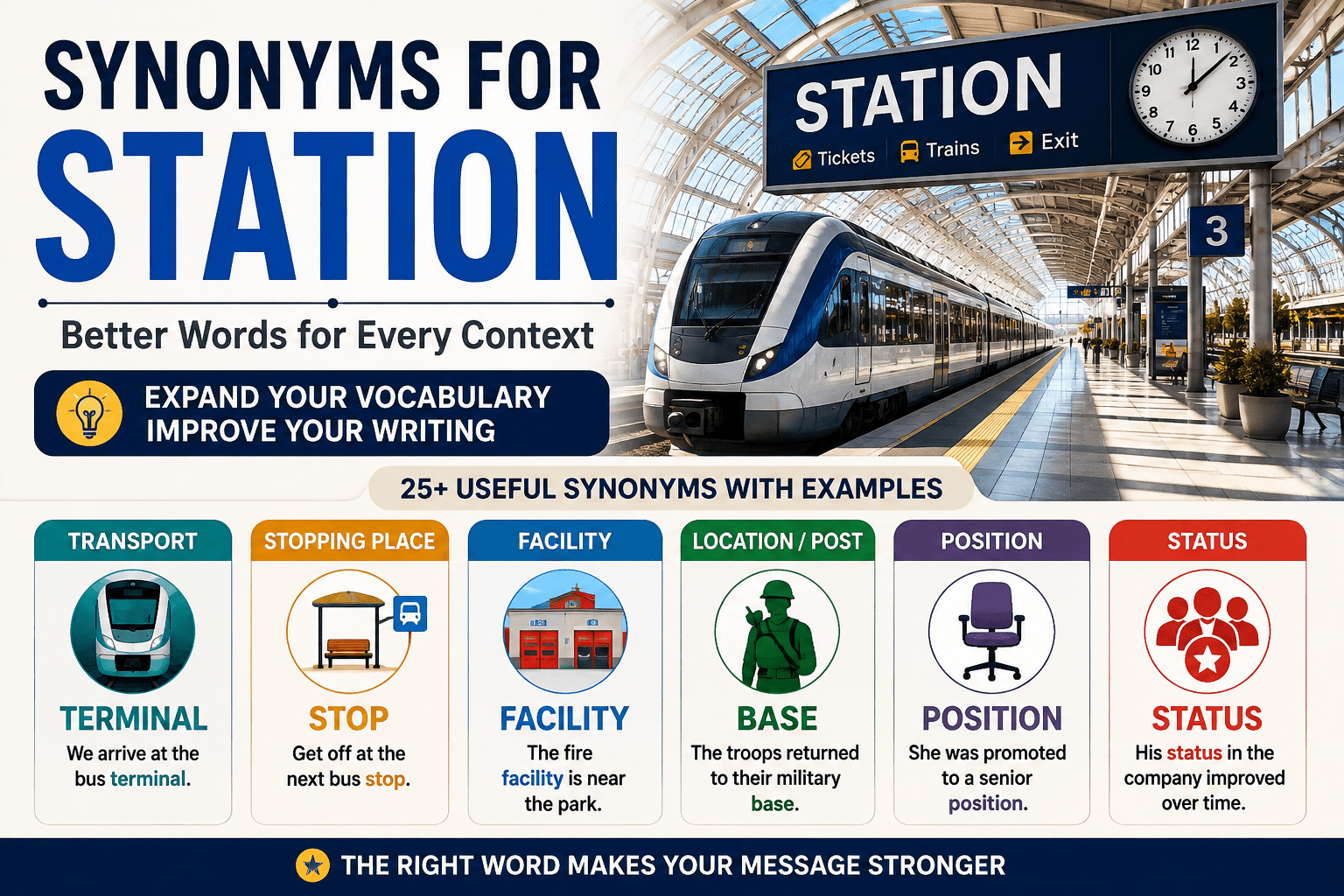
Finding the right synonym for station depends on what you mean by the word. A train station may be a terminal, depot, or stop, while a military station may be a base or post. In phrases such as social station, the word means status, rank, or position. As a verb, station can mean place, post, or position someone somewhere.
This guide separates these meanings so you can choose an alternative that sounds natural rather than simply replacing station with a loosely related word.
Quick Answer: What Are the Best Synonyms for Station?
The best synonyms for station include stop, terminal, depot, base, post, location, position, place, status, rank, and standing, depending on the meaning. ‘For transportation, terminal, depot, and stop are useful alternatives’For a military or service facility, base or post may fit.
What Does “Station” Mean?
Station is both a noun and a verb, and its meaning changes according to context.
As a noun, station can refer to:
- A place where public transportation stops
- We arrived at the train station early.
- A facility or workplace serving a particular purpose
- The firefighters returned to the fire station.
- A place where someone is assigned to work or remain
- She was transferred to a new military station.
- A person’s social or occupational position
- He married someone from a different social station.
- A broadcasting organization
- She works for a local radio station.
As a verb, station means to place someone or something in a particular location, especially for a specific purpose. Cambridge gives examples involving soldiers and guards being assigned to particular places.
Because these meanings are different, there is no single synonym that works perfectly in every sentence.
Pronunciation of Station
Station
- US IPA: /ˈsteɪ.ʃən/
- UK IPA: /ˈsteɪ.ʃən/
The pronunciation is essentially the same in standard American and British English.
The Best Synonyms for Station
Here are the most useful alternatives, organized according to meaning rather than simply listed together.
| Word | Relationship | Strength | Formality | Best Context |
|---|---|---|---|---|
| Stop | Contextual alternative | Neutral | Neutral | Transport |
| Terminal | Near synonym | Strong | Neutral/Formal | Transport |
| Depot | Near synonym | Strong | Neutral | Transport, vehicles |
| Base | Near synonym | Strong | Neutral | Military, operations |
| Post | Near synonym | Strong | Neutral/Formal | Military, assigned position |
| Facility | Contextual alternative | Broad | Formal | Services and workplaces |
| Center / Centre | Contextual alternative | Broad | Neutral | Service facilities |
| Location | Near synonym | Broad | Neutral/Formal | General place |
| Site | Near synonym | Broad | Neutral/Formal | Physical location |
| Place | Near synonym | Broad | Neutral | General location |
| Position | Near synonym | Broad | Neutral/Formal | Place or status |
| Status | Contextual alternative | Strong | Neutral/Formal | Social standing |
| Rank | Near synonym | Strong | Neutral/Formal | Hierarchy |
| Standing | Near synonym | Strong | Formal | Social reputation/status |
| Standing | Near synonym | Strong | Formal | Social position |
| Office | Contextual alternative | Specific | Neutral/Formal | Employment or function |
| Occupation | Contextual alternative | Specific | Neutral/Formal | Work |
| Employment | Contextual alternative | Specific | Formal | Work |
| Channel | Contextual alternative | Specific | Neutral | Broadcasting |
| Place | Direct/near synonym by sense | Broad | Neutral | Position/location |
Thesaurus references similarly separate station into meanings involving facilities, locations, social or occupational status, and the verb meaning “place.”
Synonyms for Station as a Train or Bus Stop
When station refers to a place where trains or buses arrive and depart, the closest alternatives are terminal, depot, stop, and sometimes transport hub.
1. Terminal
A terminal is a major transportation facility, often at the end of a route, although the word can also refer more broadly to a major passenger facility.
Example:
The passengers waited inside the main railway terminal.
Use “terminal” when: you want to emphasize a substantial transportation facility rather than simply a stopping point.
2. Stop
Stop is simpler and more general. It refers to a place where a bus, train, or other service stops.
Example:
Get off at the next bus stop.
Important distinction:
A stop may be much smaller than a station. A bus stop can consist of little more than a sign or shelter, while a station usually refers to a larger facility.
3. Depot
A depot can refer to a transportation facility where vehicles are stored, maintained, or dispatched. In some contexts, especially involving railways or buses, it can overlap with station.
Example:
The buses returned to the depot after midnight.
Best for: transport operations, vehicles, storage, and maintenance.
Cambridge specifically lists depot, stop, and terminal among related transportation vocabulary around station.
Synonyms for Station as a Facility
In expressions such as fire station, police station, service station, or weather station, the best replacement depends on the facility.
Facility
Facility is a broad formal alternative for a place equipped for a particular purpose.
The emergency facility remained open throughout the night.
Center / Centre
Center or British centre can work when the location provides a particular service.
The community center offers free language classes.
However, center is not a universal replacement for station. A fire station is not normally called a fire center, and a train station is not normally called a train center.
Base
Base works particularly well for military, operational, or organizational locations.
The soldiers returned to their base.
It is therefore a good alternative to station in some military contexts, but not for ordinary railway travel.
Synonyms for Station as a Military or Assigned Location
When station refers to a place where military personnel or other workers are assigned, useful alternatives include base, post, posting, and location.
Base
The unit returned to its base after the exercise.
Base emphasizes an operational headquarters or established location.
Post
Post can mean an assigned place or position, particularly in military, security, or official contexts.
The officer was assigned to a remote post.
Posting
Posting refers more specifically to an assignment to a particular place or position.
Her next posting was in Singapore.
Location
Location is broader and more neutral.
The company offered him a new work location.
Synonyms for Station Meaning “Position”
One of the less obvious meanings of station is position or place, especially a person’s appointed role or place in an organization.
For this meaning, the best alternatives are:
- position
- post
- place
- role
- office
- capacity
For example:
He accepted his new station within the organization.
Depending on the intended meaning, this could become:
He accepted his new position within the organization.
Or:
He accepted his new post within the organization.
Position is usually the safest modern alternative because it works naturally in professional and organizational contexts.
Synonyms for Station Meaning “Social Status”
In expressions such as station in life or social station, station means a person’s social position, rank, or standing.
The best alternatives include:
- status
- rank
- standing
- position
- social position
- class
Status
Status is the most natural modern alternative in many contexts.
His social status changed after the promotion.
Rank
Rank emphasizes position within a hierarchy.
She rose through the ranks of the organization.
Standing
Standing emphasizes someone’s recognized position, reputation, or social importance.
He has considerable standing in the academic community.
Position
Position is broader and can refer to social, professional, or organizational circumstances.
The social-status sense of station is much less common in everyday modern speech than the transportation or facility senses. It survives especially in expressions such as station in life and above one’s station.
Synonyms for Station as a Verb
When station is used as a verb, it means to place someone or something in a particular location, often for a specific purpose.
The strongest alternatives are:
- place
- position
- post
- assign
- deploy
- locate
- establish
Place
The broadest alternative.
Guards were stationed outside the building.
→
Guards were placed outside the building.
Position
Useful when emphasizing a deliberate location.
The photographer stationed herself near the entrance.
→
The photographer positioned herself near the entrance.
Post
Particularly natural for guards, soldiers, police, or officials.
Two officers were stationed at the entrance.
→
Two officers were posted at the entrance.
Deploy
Deploy implies sending people or resources into a particular location or situation, often for operational purposes.
Additional troops were deployed near the border.
It is therefore related to station but can imply a broader strategic action.
Assign
Assign emphasizes giving someone a particular duty or location.
She was stationed at the London office.
→
She was assigned to the London office.
Cambridge identifies post and send as synonyms associated with the verb station.
Closest Synonyms for Station by Meaning
| If “station” means… | Best alternative |
| Train station | terminal / depot |
| Bus station | terminal / depot |
| Small transport stop | stop |
| Military station | base / post |
| Fire station | facility / firehouse |
| Police station | police post / precinct |
| Radio station | channel / broadcaster |
| Physical location | site / place / location |
| Position | position / post |
| Social status | status / standing / rank |
| Occupational station | position / occupation / role |
| Station as a verb | place / position / post / assign |
The important point is that these are contextual alternatives, not interchangeable synonyms in every sentence.
Which Word Should I Use Instead of “Station”?
Use terminal when:
You are talking about a major transportation facility.
The train arrived at the terminal.
Use stop when:
You mean a place where a bus or train simply stops.
Get off at the next stop.
Use depot when:
You mean a transportation facility associated with vehicles, storage, maintenance, or operations.
The buses returned to the depot.
Use base when:
You mean a military or operational headquarters.
The soldiers returned to base.
Use post when:
You mean an assigned military, security, or official location.
He was sent to a remote post.
Use status when:
You mean someone’s social or professional standing.
Her status changed after the promotion.
Use position when:
You mean someone’s role, place, or standing.
He accepted a senior position.
Use location when:
You simply mean a physical place.
The station’s location is convenient.
Station vs. Terminal vs. Depot vs. Stop
These words are often confused, especially in transportation contexts.
| Word | Main Meaning | Typical Use |
| Station | Transportation facility where services stop | Train, subway, bus |
| Terminal | Major transportation facility, often at a route’s end | Airports, buses, trains |
| Depot | Facility for storing, maintaining, or operating vehicles | Buses, trains, military supplies |
| Stop | Place where a vehicle pauses for passengers | Bus, tram, train |
Station vs. Terminal
A station can be an ordinary intermediate stop, whereas a terminal often suggests a major facility or the endpoint of a route.
Station vs. Stop
A stop is generally smaller and more basic. A station usually implies a more substantial facility.
Station vs. Depot
A depot is often associated with vehicle storage, maintenance, or operational activity, whereas a station primarily serves passengers.
Common Mistakes When Using Station Synonyms
1. Treating “stop” and “station” as exact equivalents
They overlap in transportation contexts, but they are not identical.
Less precise:
The subway stop has five platforms and a large concourse.
More natural:
The subway station has five platforms and a large concourse.
2. Using “terminal” for every station
Not every station is a terminal.
The train stopped at three stations before reaching the terminal.
This sentence shows the distinction clearly.
3. Using “base” for ordinary transportation
A railway station is not normally called a base.
We met at the train station.
Not:
We met at the train base.
4. Confusing “station” with “stationary”
Station is a noun or verb.
Stationary is an adjective meaning not moving.
The guards were stationed outside.
The vehicle remained stationary.
These words are related in spelling but have different grammatical functions and meanings.
Natural Collocations with “Station”
Understanding common combinations helps you choose synonyms more accurately.
Transportation
- train station
- railway station
- bus station
- subway station
- metro station
- central station
- station platform
- station entrance
- station building
Public services
- police station
- fire station
- service station
- weather station
- filling station
Broadcasting
- radio station
- television station
- local station
- broadcasting station
Military and official use
- military station
- overseas station
- station troops
- station guards
- station an officer
The best synonym depends heavily on the collocation. For example, radio station may sometimes be discussed as a broadcaster, while train station may be described as a terminal, but neither substitution works automatically in every sentence.
Antonyms of Station
There is no single universal antonym for station because the word has several meanings.
Depending on context, possible opposites include:
- departure — when contrasting a stopping place with leaving
- movement — when contrasting a fixed position with movement
- displacement — when contrasting remaining in place with being moved
- unemployment — in some older senses involving occupation or employment
For the verb station, possible opposites include:
- remove
- withdraw
- displace
- relocate
The correct opposite depends on which sense of station is being used.
FAQ About Synonyms for Station
What is another word for station?
The best alternative depends on the meaning. Terminal, depot, and stop work for transportation; base and post work for military contexts; position, status, and standing work for social or occupational meanings.
What is a synonym for train station?
Common alternatives include railway terminal, railroad station, terminal, depot, and sometimes stop. However, terminal often suggests a major facility or endpoint, while stop can refer to a smaller stopping place.
What is another word for bus station?
Depending on the context, bus terminal, bus depot, or coach station may work. A bus stop usually refers to a smaller place where buses pick up or drop off passengers.
What is a synonym for station meaning status?
The closest alternatives are status, standing, rank, position, and social position. Status is generally the most natural modern choice.
What is a synonym for station as a verb?
Useful alternatives include place, position, post, assign, deploy, and locate. The best choice depends on whether you want to emphasize location, assignment, or operational deployment.
Is “terminal” a synonym for “station”?
Sometimes. A terminal is a type of transportation facility and can overlap with station, but the words are not interchangeable in every context.
Is “stop” the same as “station”?
Not exactly. A stop is a place where a vehicle stops, while a station usually refers to a more substantial passenger facility. A station can be a stop, but not every stop is a station.
What is the difference between station and position?
Station can mean a person’s assigned or social position, but position is much more common in modern English for jobs, roles, and organizational placement.
Conclusion
The best synonym for station depends on its meaning. For transportation, choose terminal, depot, or stop when the context fits. For military or official assignments, base and post are useful alternatives. When station refers to social or occupational standing, status, position, rank, and standing are usually more natural.
The safest approach is not to search for one universal replacement. First identify what station means in your sentence, then choose the synonym that preserves that exact sense.

Daniel Carter is a professional content strategist and language enthusiast. He focuses on semantic SEO, keyword research, and creating structured vocabulary content that ranks well on search engines while remaining user-friendly.