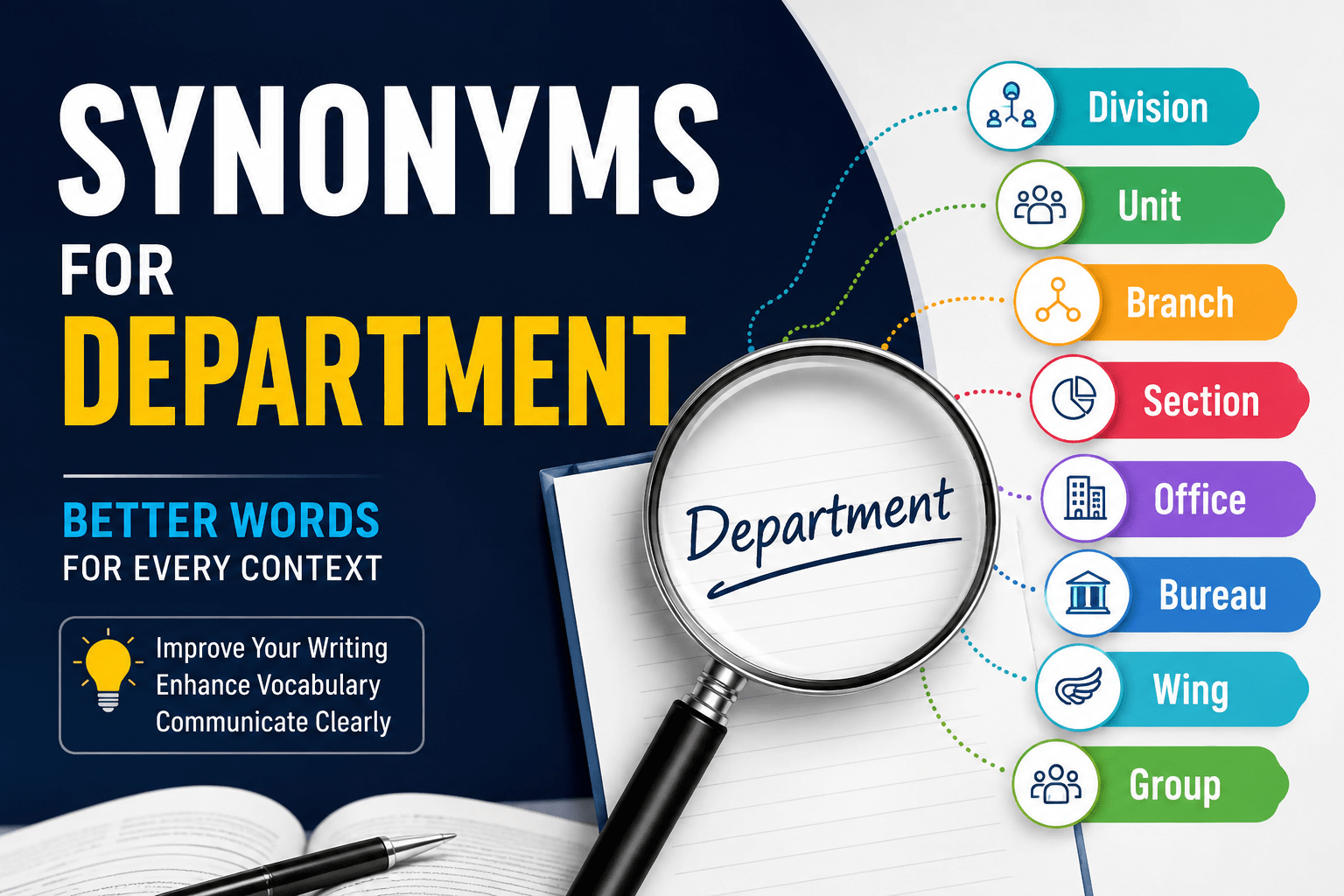
If you need another word for department, the best choice depends on what kind of organization or structure you mean. Common alternatives include division, branch, section, unit, bureau, office, and sector, but these words are not completely interchangeable. Some describe organizational subdivisions, while others are more appropriate for government, business, retail, or academic contexts.
This guide explains the closest synonyms for department, how they differ, and which word sounds most natural in professional, academic, and everyday English.
Quick Answer
The closest synonyms for department include division, branch, section, unit, bureau, and office. Division is often the strongest general alternative when referring to a major part of an organization. Section and unit usually suggest smaller subdivisions, while bureau and office are especially useful in government or administrative contexts. The best synonym depends on the organization’s structure and the specific function being described.
What Does “Department” Mean?
Department is a noun that usually means a distinct part of an organization responsible for a particular area of work, study, or activity.
For example:
- the marketing department
- the finance department
- the English department
- the human resources department
- the customer service department
Cambridge defines department as a part of an organization such as a school, business, or government that deals with a particular area of study or work. It also uses department for certain administrative divisions of a country, such as French departments.
Pronunciation:
- US: /dɪˈpɑːrt.mənt/
- UK: /dɪˈpɑːt.mənt/
The common written abbreviation is dept.
In ordinary organizational English, department often implies a recognized functional area within a larger institution.
The accounting department handles the company’s financial records.
The Best Synonyms for Department
Not every word associated with department is a perfect substitute. Cambridge’s thesaurus specifically lists division, bureau, branch, section, and unit among its synonyms, while district, division, province, and sector apply to the geographical or administrative sense.
| Word | Relationship | Typical Size/Role | Best Context |
|---|---|---|---|
| Division | Direct/near synonym | Often major | Business, organizations |
| Branch | Near synonym | Organizational subdivision | Companies, government |
| Section | Near synonym | Usually smaller | Organizations, documents |
| Unit | Near synonym | Functional group | Business, military, healthcare |
| Bureau | Contextual alternative | Administrative office | Government, administration |
| Office | Contextual alternative | Administrative function | Government, business |
| Sector | Contextual alternative | Broad area | Industry, economy, organizations |
| Team | Related alternative | People working together | Modern workplaces |
| Agency | Contextual alternative | Separate organization | Government, public services |
1. Division
Division is one of the closest alternatives to department, especially when describing a substantial part of a company or other large organization.
Best used for: major organizational subdivisions.
The company created a new division for international operations.
Department vs division: These terms overlap considerably. In some organizations, a division is larger than a department; in others, the naming hierarchy is different. Therefore, division is a strong alternative, but it does not guarantee exactly the same organizational level.
Best choice: Use division when you want to emphasize a significant organizational subdivision.
2. Branch
Branch refers to a part of a larger organization, system, or institution. It often emphasizes that the part operates as an extension of the larger organization.
She works in the research branch of the organization.
Branch is especially natural for government organizations, financial institutions, companies, and organizations with distinct operational arms.
It can also refer to a geographically separate office:
The bank opened a new branch downtown.
Because of this, branch is useful but is not always interchangeable with department. A department usually identifies a function, while a branch can emphasize an organizational or geographic subdivision.
3. Section
Section usually suggests a smaller part of an organization, institution, document, or larger structure.
He works in the publications section of the library.
It is a natural alternative when the organizational part is relatively small or when the institution itself uses section as its official terminology.
Section can sound less hierarchical than department.
Compare:
She works in the finance department.
with:
She works in the finance section.
The first sounds like a standard formal organizational division; the second may suggest a smaller subdivision within a larger department or institution.
4. Unit
Unit describes a distinct group or functional part of a larger organization.
The company established a special research unit.
It is particularly useful when the emphasis is on a group performing a specific function rather than on the organization’s formal administrative hierarchy.
Common expressions include:
- research unit
- business unit
- operations unit
- clinical unit
- intelligence unit
Unit is therefore a flexible professional alternative, but its meaning can vary substantially by field.
5. Bureau
Bureau is an administrative office or organizational division, especially one associated with government or public administration.
The case was referred to the appropriate government bureau.
It can sound more bureaucratic or institutional than department.
In American English, bureau is especially familiar in names of government organizations. It is not normally the best replacement for an ordinary company department such as the marketing department.
Use bureau when: the context is administrative, governmental, or institutional.
6. Office
Office can sometimes replace department, particularly when referring to an administrative function or government organization.
Please contact the admissions office for more information.
The matter was sent to the regional office.
However, office does not always mean the same thing as department. It can refer to:
- a place where people work
- an administrative function
- an official position
- a local organizational branch
For that reason, it is best considered a contextual alternative, not a universal synonym.
7. Sector
Sector refers to a particular part or area of a larger system. It is often broader and less organizationally specific than department.
She works in the public sector.
The technology sector has changed rapidly.
Using sector instead of department can change the meaning considerably. A department is normally a defined organizational unit; a sector can refer to a broad area of an economy, industry, society, or organization.
Use sector when: you are describing a broad area rather than a specific internal department.
8. Team
Team is a useful modern workplace alternative when the focus is on the people performing a function rather than the formal organizational structure.
I’ll ask the marketing team to review the proposal.
This does not always mean the same thing as department.
A department may contain several teams:
The marketing department has three regional teams.
So team is better treated as a related organizational term rather than a direct synonym.
9. Agency
Agency can sometimes function as an alternative to department, especially in government and public-service contexts, but it generally refers to an organization or administrative body rather than simply an internal division.
The environmental agency issued new guidelines.
It would usually be incorrect to replace marketing department with marketing agency because an agency has a different organizational meaning.
Use agency when: referring to an independent or semi-independent organization that performs a particular public, administrative, or professional function.
Closest Synonyms vs Contextual Alternatives
A major mistake in synonym writing is treating every related organizational word as interchangeable.
Closest alternatives
These can often replace department, depending on the organizational structure:
- division
- branch
- section
- unit
Context-specific alternatives
These work naturally in particular settings:
- bureau — government or administration
- office — administrative functions or government
- sector — broad fields or areas
- agency — separate administrative or public-service organizations
Related but not equivalent
- team
- group
- committee
- staff
- organization
These describe related organizational concepts but do not necessarily mean department.
Which Word Should I Use?
The easiest way to choose the right alternative is to identify what you are actually describing.
Use “division” when:
You mean a substantial part of a large organization.
The company expanded its international division.
Use “branch” when:
You want to emphasize an organizational arm, extension, or separate location.
The organization opened a regional branch.
Use “section” when:
You mean a smaller subdivision.
Contact the admissions section for assistance.
Use “unit” when:
You are emphasizing a specialized functional group.
The hospital created a new cardiac unit.
Use “bureau” when:
The context is governmental or administrative.
The request was forwarded to the relevant bureau.
Use “office” when:
You mean an administrative function or official organizational office.
Please contact the admissions office.
Use “sector” when:
You mean a broad field rather than a specific internal division.
She has worked in the education sector for years.
Use “team” when:
You are focusing on people rather than organizational hierarchy.
Our design team is reviewing the project.
Department vs Division
Department and division are among the most easily confused terms.
Both can describe a formal part of a larger organization, but the hierarchy varies between organizations.
A division often sounds like a major organizational subdivision:
The company’s technology division employs hundreds of people.
A department often identifies a particular functional area:
The technology department manages the company’s internal systems.
In some companies, departments sit inside divisions. In others, the two terms may be used at roughly the same organizational level.
Bottom line: division is one of the closest alternatives to department, but organizational terminology is not standardized across every institution.
Department vs Section
The main difference is often organizational scale.
A department commonly represents a recognized functional area:
the finance department
A section may represent a smaller subdivision:
the payroll section
However, some organizations officially call their functional areas sections, so the distinction depends on the institution.
For general professional writing, “department” is usually safer when you mean a formal organizational area.
Department vs Branch
The distinction is primarily about function versus organizational extension.
A department typically handles a particular function:
the human resources department
A branch may represent a separate arm, location, or operational extension:
the company’s New York branch
Therefore, branch is not always a direct substitute for department.
Department vs Team
A department is usually an organizational structure; a team is primarily a group of people working together.
The sales department has five regional teams.
This sentence demonstrates why the two terms should not automatically be treated as synonyms.
Use department when discussing organizational structure and team when discussing the people carrying out the work.
Common Collocations with “Department”
Some combinations with department are especially natural in English:
- accounting department
- finance department
- sales department
- marketing department
- human resources department
- research department
- legal department
- education department
- customer service department
- engineering department
- English department
- chemistry department
- government department
Cambridge’s Business English material similarly gives common combinations such as sales, human resources, and finance department, and identifies department as a standard term for a part of a large company or university dealing with a particular area of work or study.
When replacing department, check the collocation carefully. A synonym may be grammatically possible but unnatural in a particular phrase.
For example:
finance department — very natural
finance division — natural in many organizations
finance team — natural when referring to employees
finance bureau — usually inappropriate unless it is an official administrative body
Formal and Professional Alternatives
For professional writing, the strongest alternatives are usually:
- division
- branch
- unit
- section
- office
The best choice depends on the organization’s actual structure.
For example:
Original:
The department is responsible for employee training.
Possible alternatives:
The division is responsible for employee training.
The unit is responsible for employee training.
The team is responsible for employee training.
Each sentence can suggest a slightly different organizational structure. If accuracy matters, retaining department may actually be better than forcing a synonym.
Common Mistakes
Mistake 1: Treating every related word as a synonym
Words such as team, group, and agency are related to department, but they do not necessarily have the same meaning.
Mistake 2: Using “sector” for every department
A sector is often a broad area of activity, not a formal internal organizational division.
❌ I work in the company’s finance sector.
✓ I work in the company’s finance department.
The first sentence may be meaningful in a different context, but it does not necessarily identify an internal department.
Mistake 3: Assuming “division” always means a larger department
Organizations use these terms differently. There is no universal rule that every division must be larger than every department.
Mistake 4: Replacing “department” when no replacement is better
Synonyms are useful when they improve precision, avoid repetition, or suit a particular context. If department is the clearest and most natural word, keep it.
Antonyms of Department
Department does not have a single direct antonym because it primarily describes a structural relationship.
Depending on the intended contrast, possible concepts include:
- whole
- organization
- entirety
- parent organization
These are not strict dictionary antonyms. They simply represent the larger entity of which a department may be a part.
FAQ
What is another word for department?
Common alternatives include division, branch, section, unit, bureau, and office. The most appropriate choice depends on the organization’s structure and context.
What is the closest synonym for department?
Division is often the closest general alternative, especially when referring to a major part of a company or organization. However, department and division can have different hierarchical meanings within different organizations.
What is a formal synonym for department?
Division, unit, section, bureau, and office can work in formal contexts, but their suitability depends on the type of organization.
What is a synonym for department in a company?
Division, branch, unit, and sometimes team can work, depending on the company’s organizational structure. Division is generally one of the closest alternatives.
Is “team” a synonym for department?
Not exactly. A team is a group of people working together, whereas a department is usually a formal organizational division. A department can contain several teams.
Is “section” the same as department?
Not always. A section can be a smaller subdivision within a department, although some organizations use section as the official name for a functional area.
What is the difference between department and division?
Both can describe organizational subdivisions, but their relative size and hierarchy vary by organization. Division often suggests a major subdivision, while department commonly identifies a particular functional area.
Can “office” replace “department”?
Sometimes. Office works particularly well for administrative functions and government organizations, but it is not a universal replacement for department.
Conclusion
The best synonyms for department are division, branch, section, unit, bureau, and office, but they are not interchangeable in every situation.
Use division for a major organizational subdivision, section for a smaller part, unit for a specialized functional group, branch for an organizational arm or location, bureau for administrative or governmental contexts, and office for many administrative functions.
The most important rule is simple: choose the word that accurately describes the organization’s structure rather than replacing “department” merely to avoid repetition.